From the founder of Biography Studio
Most people who start a Biography Studio project open their first chapter, read a question, and answer it. That is a perfectly reasonable thing to do, and if it is how you work best, carry on. The book you make will be yours and it will be worth having.
But there is another way to approach this. A way that tends to produce richer answers, surfaces things you did not know you still remembered, and makes the process itself more rewarding. It starts with understanding something about how memory actually works.
How memory stores and retrieves the past
Memory researchers have consistently found that autobiographical memory, the kind involved in recalling your own life, is not stored as a set of complete scenes you can simply play back. It is organised in layers.
At the top are lifetime periods: a general sense of a time, an era, a phase of life. Ask someone to think about their childhood and what comes back is usually a feeling, a vague impression, perhaps a fragmentary image. This is the surface layer. It is real, but it is not where the detail lives.
Beneath it are general events: the things that happened repeatedly, the patterns of a life. Sunday evenings. The summer holidays. The drive to school.
Beneath those are specific memories: single moments, tied to a particular time and place, complete with sensory detail. The smell of a particular kitchen. The sound of a specific voice. The feeling of a summer evening when you were eight years old and could hear other children still playing outside while you were supposed to be asleep.
This is where the richest material lives. And this is also the layer that casual reminiscing rarely reaches.
The reason Biography Studio questions are written the way they are is precisely this. A question specific enough to ask for one thing: a particular home, a particular person, a particular moment, works as a precise retrieval cue, descending through the layers to where the detail is stored. Vague prompts produce vague impressions. Specific questions produce something else entirely.
Research into autobiographical memory has also consistently shown that sensory cues are among the most powerful retrieval tools available. Music in particular has a well-documented ability to unlock memories that are more vivid, more emotionally rich, and more episodically detailed than those retrieved through words alone. Smell works similarly. An old photograph, a familiar object, a song from a particular decade: these are not just nostalgic triggers. They are mechanisms for accessing layers of memory that would otherwise stay sealed.
Understanding this changes how you approach the questions.
Prepare before you answer
The single most effective thing you can do before answering a question is read it, then close the laptop. Give it a day or two before you come back to answer it.
Memory researchers have found that the brain continues processing material long after conscious attention has moved on. A question read on a Monday evening and returned to on Wednesday will often produce a noticeably richer answer than one answered on the spot. The brain works on it in the background. Relevant material surfaces, names, details, associated memories, that were simply not accessible in the moment of first reading.
You know the experience of thinking of exactly the right thing to say two hours after an argument has ended. The same mechanism is at work here. The answer that matters is rarely the first one that comes. It is the one that surfaces after the question has had time to settle.
This does not mean every answer requires days of preparation. Some questions will come quickly and easily. Others, particularly in the chapters that cover more emotionally significant territory, will benefit from being left to breathe for longer.
A simple approach: at the start of a week, read through the questions in one or two chapters without answering any of them. Note which ones catch you. Then close the laptop and let them sit. Return a day or two later with a notebook full of what has come back in the meantime.
Capture before it fades
Memory surfaces at unexpected moments. In the shower. On a walk. In the middle of the night. The name of a neighbour you had forgotten entirely. The specific detail that would make an answer complete. The person who was present at a moment and whose name you could not have retrieved if asked directly.
If you do not write these things down when they come, they will slip away again.
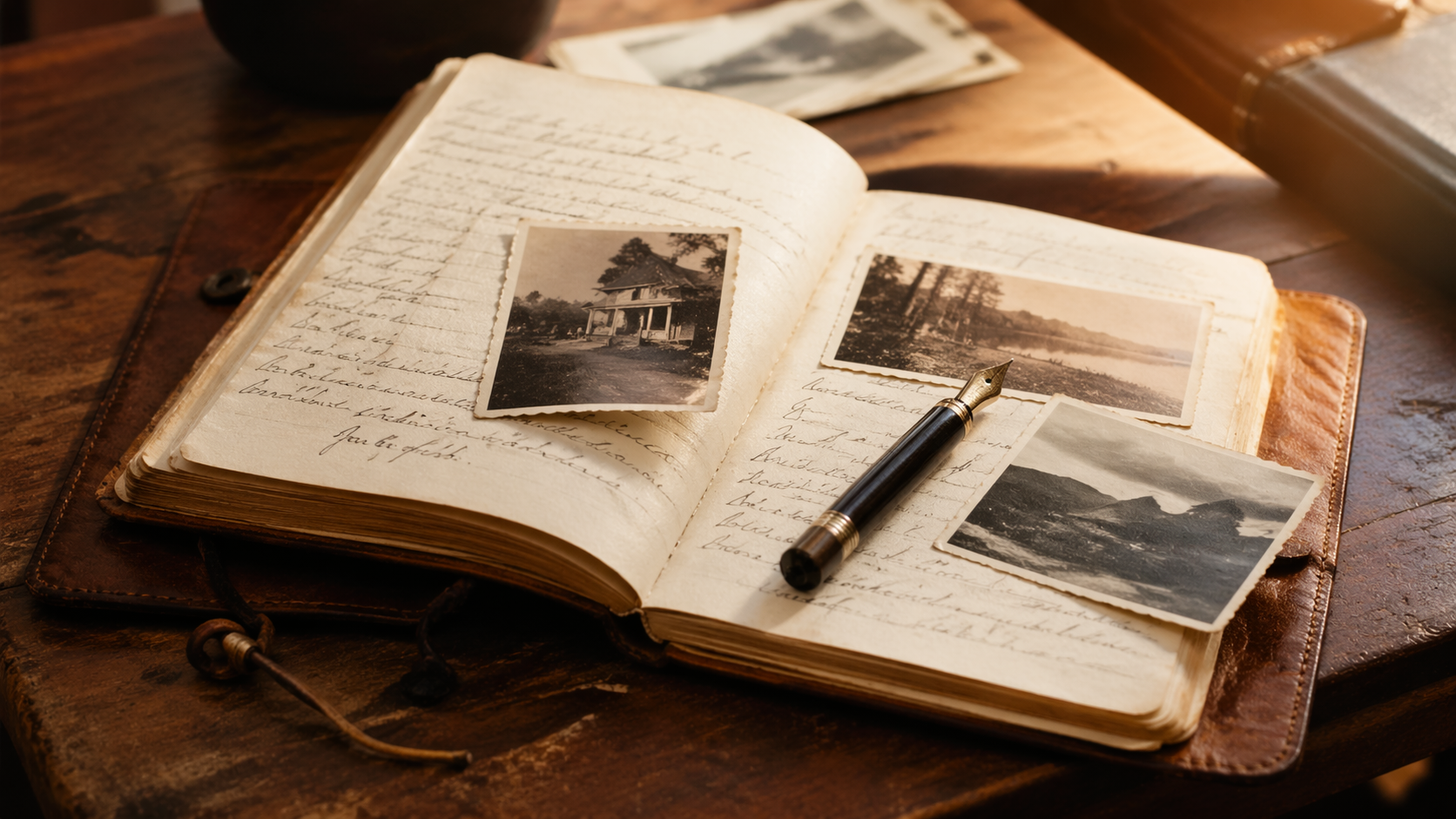
Before you begin answering questions in earnest, buy yourself a notebook. A physical one, and ideally one you actually like the look and feel of. Not a scrap of paper, not the back of an envelope. Something with a bit of weight to it. This notebook is going to become a companion to your project, and it deserves to feel like one from the start. Keep it with you and use it only for this. Write names, fragments, sensory details, questions you want to ask a sibling or an old friend. Tuck photographs into it. A torn corner of a letter. A receipt from somewhere that takes you back.
The notebook serves a practical purpose: it means the material is there when you need it. But it also does something subtler. Looking through old photographs with a specific question in mind produces different results from looking at them generally. The question focuses the attention. The detail you notice changes.
By the end of a project you will have filled the notebook with fragments of a life being recovered. It becomes something in its own right, a companion to the book, the raw material from which the answers were made.
Shape what you have found
Once the material is there, the question is what to do with it.
There is a meaningful difference between an answer that records something and an answer that makes someone feel they were there. The difference is almost always specificity.
“We used to go on holiday to the same place every summer” is a true sentence. It conveys information. It does not put anyone inside the memory. The same recollection shaped differently might begin with the smell of the car on the first morning, the flask of coffee that appeared every year without fail, the argument about the map that also appeared every year without fail, and the moment you crested a particular hill and saw the sea for the first time and felt, properly, that the holiday had begun. That is an answer someone will still be reading in fifty years.
Sensory detail is the key. What did it smell like. What was the light doing. What were people wearing. What was the name of the dog, the teacher, the street. The more specific an answer is, the more vividly it places the reader in the scene. Vague answers, even long ones, leave the reader at a distance. Specific answers pull them in.
A good answer also tends to have a shape. Not a formally constructed narrative, but a direction. A beginning, somewhere to go, and somewhere to land. It does not need to end with a conclusion or a lesson. It might end with a small detail, a feeling, a single observed thing. But it should arrive somewhere rather than simply stopping.
If you are speaking your answers rather than typing them, take a moment before you start recording. Think about where the memory begins and roughly where you want it to end. The editing process will handle the hesitations, the repeated phrases, the roughness of spoken language. What it cannot do is give an answer a shape it does not already have. That part is yours.
A note on pace
Everything above makes for better answers. It also makes for a different kind of experience than simply working through the questions as efficiently as possible.
There is a reason for that, and it is worth saying briefly here. Biography Studio is not primarily a book production service. It is an opportunity, perhaps one of the few sustained ones most people ever have, to step back from the immediate business of living and look at the whole of a life from a distance. The answers you write are the record. The process of finding them is something else.
We have written more about that here, and if you are at all interested in what this project is capable of giving you beyond the book, it is worth reading. For now: the craft matters. Follow the steps above and your answers will be richer for it. But do not be in a hurry.
The cheat sheet
Everything above, distilled into four steps to keep beside you as you work.
Step 1. Understand how your memory works. Your memories are stored in layers. The richest detail lives at the bottom, not the surface. Biography Studio questions are designed to take you there. But only if you give them the chance.
Step 2. Read the question. Then close the laptop. Give it a day or two before you answer. Your brain will work on it without you. Names, details, and associated memories will surface in the meantime that were simply not accessible when you first read it. Jot them down as they come.
Step 3. Buy a notebook before you begin. A proper one, something you like the feel of. Keep it with you throughout the project. Write fragments, names, details, things that come back unexpectedly. Look at old photographs with the question in mind. Talk to people who were there. By the end of the project, the notebook will be something worth keeping in its own right.
Step 4. Shape the answer before you give it. Know roughly where it starts and where you want it to land. Lead with the specific, not the general. The name, the smell, the detail that puts someone inside the memory rather than outside it. The editing process handles the rough edges. The shape is yours to bring.
Biography Studio guides you through your life story, in your own words, at your own pace. The questions are designed to take you somewhere. Let them.