From the founder of Biography Studio
Many people who have completed a Biography Studio project have described it as one of the most rewarding experiences of their lives. Several have said it changed how they see themselves. Most have said they cried.
At the end of the process they receive a beautifully produced hardback book. Their story, in their own words, built to last and built to be read and treasured by themselves and by the people they love.
But it is not what moved them.
This piece is about what did.
What happens while you are making it
The first thing most people notice is that specific questions unlock things that general reflection never does.
Most of us have a version of our own past that lives in our heads as a kind of highlight reel, the same handful of stories, told the same way, with the same details emphasised. This is not memory. It is a shortcut to memory. The full thing is still there, stored in layers, but most of us never reach it.
Biography Studio is designed to help you unearth those rich, deeply buried memories. We do so by the way we formulate the questions. When you are asked not to remember your childhood generally, but to go back to a specific house on a specific street and describe what the kitchen smelled like, something happens. You find yourself somewhere you have not been in forty years. And behind that, without being asked, come the other things. The name of the neighbour whose house you were never quite allowed into. The ritual that happened every Sunday that you had not thought about since it stopped. The version of a parent you knew when they were younger than you are now.
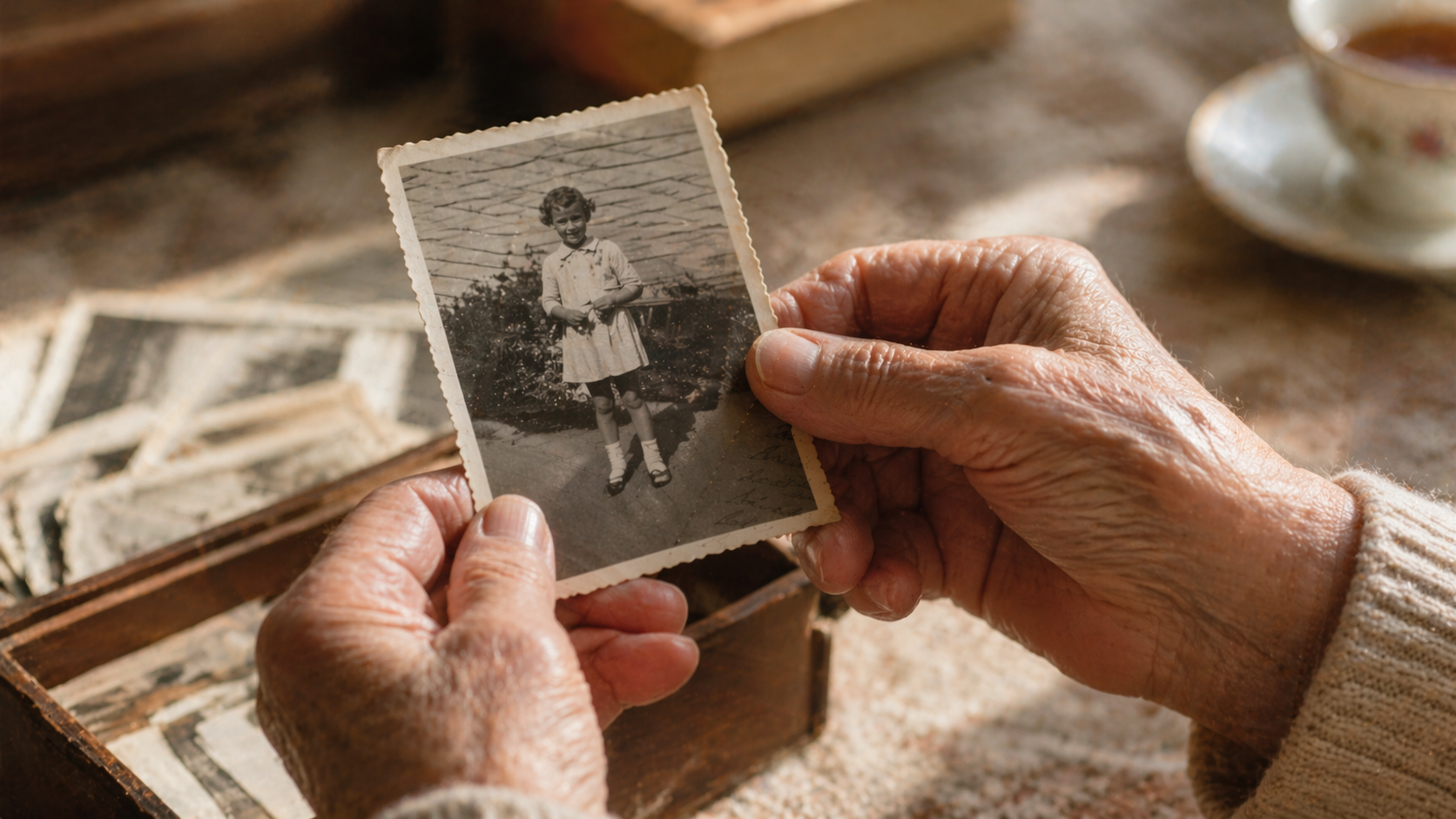
These are not things you retrieve. They surface. And they bring with them a feeling that is difficult to describe and impossible to reach any other way. The warmth of seeing yourself as a small child in a world that was, at the time, entirely sufficient.
When going back, the particular feeling that surfaces is hard to name precisely. You are remembering events that happened, but the emotions attached to them are different now. The same childhood kitchen. The same Sunday ritual. The same characters, seen through the lens of where you are now and everything that has happened in between. There is a tenderness that was not available to you at the time. A warmth for the people in those early scenes that only a full life of experience can produce. Some of it is tinged with melancholy, because that world is gone and cannot be directly accessed again. But mostly what people describe is something closer to gratitude. A deep appreciation for what was there felt from a new vantage point.
And that is just Chapter 1.
The chapters that go further
As a project progresses, it moves through the stages of a life. Childhood. School. The formation of identity. The untethered years of early adulthood. Love and the people who have mattered. The shape of everyday life across the decades.
Each chapter reaches somewhere specific. The chapter on relationships tends to produce a reckoning with how much love has actually been present in a life. How much love has been given and received, how many people have mattered, and in some cases the particular feeling of something finally being said that has always been true but never quite found words.
The Wisdom chapters, the final three, ask about the values you have lived by, the lessons that only experience could teach, and what you want to leave behind. People who have worked through them consistently describe the same experience: sitting down to answer and discovering, with a force they did not anticipate, how much they have to say. How much they have thought about. How much they want someone they love to one day hear.
The arc of it
There is something that happens across the full sweep of a Biography Studio project that is worth naming, because it does not announce itself until you are most of the way through.
When you begin, you are writing about a child. A small, self-contained world. A life that was entirely inward-facing, shaped by the family you were born into and the small territory that family occupied. Everything was about you, in the way that childhood always is.
As the chapters progress, that world expands. Other people enter it. Relationships form. Losses arrive. A career takes shape. A family is built, or a choice is made not to build one. The world presses in, and you press back, and somewhere in the middle of all of that, somewhere in the chapters about love and work and the shape of daily life, you notice that the things that matter most are no longer about you at all. They are the people you have made your life with. The things you have made for others. The love you have given, not the love you have received.
By the time you reach the final chapters, and the questions ask what you want to leave behind and who you are writing it for, you understand what the project has been doing all along. It has been showing you the arc.
When you are small, the world is small. Everything that matters is inside you. You are the centre of it, in the way that children simply are, without guilt or apology. But somewhere across the decades, something shifts. Gradually, almost without noticing, the things that matter most move outside you. The family you have built. The people you love. By the time you arrive here, at this stage of life, the most important things in the world are no longer about you at all. You would give anything for them. You would give yourself.
That movement, from the child at the centre of everything to the person whose everything is other people, is one of the most profound things a life does. Most people never see it clearly. We are too close to our own experience, managing the immediate, living inside the moment rather than above it. A Biography Studio project creates the distance. Going back through it, chapter by chapter, is one of the few ways to see it whole.
The science, briefly
This is not just a Biography Studio observation. Researchers who study wellbeing in later life have consistently found that structured life review, going back through a whole life, stage by stage, with specific prompts, produces measurable improvements in life satisfaction, psychological wellbeing, and sense of meaning. The key word is structured. Simple reminiscing produces some benefit. Structured review, which takes the full span of a life seriously and asks specific questions about each stage, produces significantly more.
The psychologist Erik Erikson, whose developmental model is one of the most influential in twentieth century psychology, identified a final stage of human development in which the central task is exactly this: making sense of a whole life. Looking back at everything, the achievements and the failures, the relationships and the losses, the choices made and not made, and arriving at something he called integrity. A peaceful sense that the life was coherent. That it meant something.
The route to integrity, in Erikson’s framework, is not luck or circumstance. It is the willingness to look. To go back through everything, clearly and without flinching, and find the meaning that was there. A Biography Studio project is, structurally, that process. Up to thirteen chapters. A whole life. Every stage given its proper weight.
The gift to yourself
The book at the end of a Biography Studio project is for the people you love. It is the record that would otherwise not exist, the stories that would otherwise go untold, the version of you that your grandchildren might one day want to know.
But the process is yours.
The quiet hours with a question in front of you and a memory beginning to surface. The realisation, arriving unexpectedly somewhere in the middle chapters, of how much there has been. How many people. How many moments. How much of a life you have already lived and not yet properly seen.
People come out of this process feeling something close to gratitude. Not for anything in particular. For the whole of it.
That is not incidental to what Biography Studio does. It is the point.
While there is still time to feel it clearly, begin.
Biography Studio guides you through your life story, in your own words, at your own pace. If you are ready to begin, or simply want to understand more about the process, start here.