
From the founder of Biography Studio
Whether you are telling an anecdote about a holiday, writing a scene in a story, describing the village where a friend grew up, or trying to bring back the house you spent your childhood in, you are trying to take someone with you into a place they have never been, and make them feel they have.
Most people, when they try, begin with the wrong details. The address. The country. The number of bedrooms. The year. These facts are not necessarily irrelevant, but they cannot transport anyone. They are the kind of details that go on the cover of an estate agent’s leaflet, or in the opening line of a guidebook. They tell a listener nothing about what the place actually was.
Take the house you grew up in. There is one that lives in your memory in extraordinary detail. You can walk through it from the front door to the back room without having to think. You know which floorboards creaked. You know what the kitchen smelled like on a Sunday. You know exactly where the light fell on the dining table at four o’clock in the afternoon in winter. If someone asked you to describe it, though, the chances are you would still begin with the address. The same instinct that flattens an anecdote about a holiday flattens the description of a place that shaped you. This piece is about how to do it differently.
It is the second practical piece in a short series applying the principles set out in How to Tell Stories So People Hang on Every Word, to specific kinds of memory. This one is about places.
Walk through it
A place lives in your memory spatially, not as a list. When you remember the house, you remember moving through it. The front door. The hallway. The room on the right. The stairs.
Describe it in the same way. Take your listener with you. Open the door. Step into the hallway. Tell them what was on the left first if that is what you would have seen first. The route through a place is the route through the memory of it.
This is not just a stylistic choice. It is how memory itself works. When you walk a remembered space in sequence, more comes back than if you try to recall it as a whole. The kitchen door reminds you of the cat that always slept on the mat outside it. The cat reminds you of the time it brought a mouse in. None of that surfaces if you try to picture the house as a layout. It surfaces when you put yourself back into the space as a body, moving through it the way you used to.
The same is true for the road you walked to school, the garden you played in, the corner shop you went to every Saturday morning for sweets. It is true for the village where you stayed on holiday, the city you spent a week in twenty years ago, the office you used to work in. Move through it in your mind as you would have at the time. The order is the cue. The further you walk, the more comes back. The piece on how memory works explains the mechanism behind this in more depth. The practical point is that the walk does the recalling for you. You do not have to summon detail in advance. The detail surfaces as you move.
This walking is how you recover the memory. It is not necessarily how you deliver it. When you sit down to tell the story or write the answer, you will not march the listener room by room from the front door. You will choose one moment, one corner, one room. The walking has done its work in giving you the material. The choosing is what shapes it.
What you noticed, not what was there
The second move is to describe a place from inside it, not from above. From the level of your eye and your body, not from the level of a floor plan.
A place described from above sounds like a property listing. A three-bedroom semi-detached house on a quiet residential street. South-facing garden. Original Victorian features. These details might be true, but no one has stood inside the house. The reader is being shown a brochure.
A place described from inside it sounds like a life. The carpet in the hallway was patterned in muddy red and brown, and there was a stain near the front door from where the dog had been sick the Christmas before. The radiator hummed. The light bulb in the hall fitting had been broken since you could remember and no one had ever replaced it.
That second version is doing something the first cannot. It is putting the listener at eye-level with someone who actually lived there. It is choosing the details a small child noticed, not the details a buyer would ask about. Joan Didion wrote about California from this position throughout her career. Not the geography of Sacramento, but the specific things you would notice if you lived there. Not the layout of a Hollywood house, but the texture of being in it. That is the level a listener needs to be brought to.
Take her essay “On Going Home,” in which she returns to her parents’ house in California’s Central Valley with her husband. The piece is not about the property’s architecture or the size of the rooms. It is about the way her family speaks when they are together, the people they mention whose names her husband has never heard, the dynamics that only emerge when she is back inside the house she grew up in. The house comes alive through the texture of being in it, not through description from outside.
These are the details that make a place yours. The crack in the bathroom tile that looked like an aeroplane. The way the back door would not quite close in summer when the wood had swollen. The particular sound the gas boiler made before the heating came on. None of these things would be in a property listing. All of them are what the house actually was.
The same applies to anywhere. The taverna on a Greek island, described well, is not the menu or the view but the plastic tablecloth and the cat that lived under the next table. The office, described well, is not the floor plan but the way the printer used to jam at the same point every Tuesday. The detail you noticed because you were there is the detail that brings the listener with you.
There is a second thing happening here. These details do more than transport the listener. They tell them what kind of place it was. The cat under the table tells you the taverna was rustic and family-run. Somewhere animals wandered in and out. Intimate, not a chain. The printer that jammed every Tuesday tells you the office was small enough that no one had ever got round to fixing it. That the same problem had been tolerated for long enough to become part of the furniture. A well-chosen detail carries the character of a place alongside its picture. It tells the listener what kind of place this was, not only what was in it.
The scene inside the room
The third move is to find what happened in the place. A specific occasion, or the kind of repeated moment whose texture lived there.
A room described in the abstract is a stage set. A room with a scene inside it is a living place. There are two ways this can work.
The first is the place as a container for an event. Something happened there, and the room held it.
The kitchen had a small table under the window. The chairs did not match. There was a calendar on the wall from the local garage with a different photograph for each month. That is the room as a set.
The afternoon my father came home from the hospital, he sat at the small table under the window and looked at the calendar for a long time without saying anything. The chairs did not match. None of us spoke. The fridge hummed. That is the room as a place where a life was lived.
The details about the kitchen are the same in both versions. What has changed is that there is now a moment inside it, and the room has become the container for the moment. The listener is no longer looking at the room. They are sitting in it.
The same technique works whatever the event. The evening my grandfather found out his wife had died, he came home and sat down in the armchair he had always sat in. He had a habit of running his thumb along the worn fabric of the arm without noticing. He did it then, for a long time, looking at nothing in particular. The chair is not introduced as a piece of furniture. It surfaces through the gesture. The gesture carries the moment.
The second way is the place as the memory itself. There is no single event. The scene is a kind of evening, or a kind of afternoon, distilled into the sensory texture that belonged to this room and nowhere else.
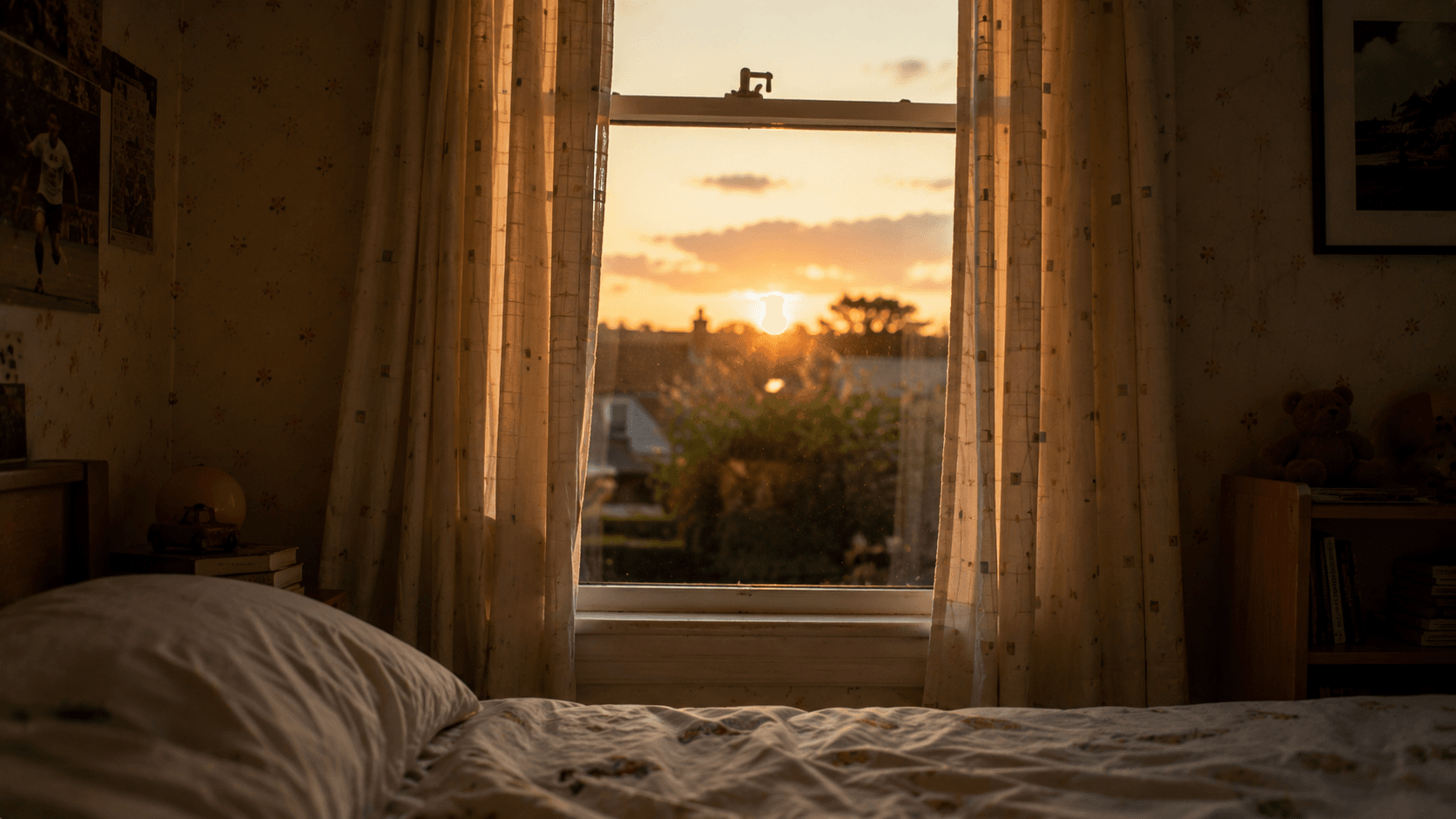
Going to bed on a hot summer evening with the curtains still open, the smell of cut grass coming in through the window. The sound of children still playing outside as the light went down. The cotton sheet against your legs. The wallpaper at eye-level. That feeling of being sent up too early.
Nothing happens in the conventional sense. But the room is fully inhabited. The listener is in it.
The choice between the two depends on what you actually remember. If a particular event lives in the place, use the event. If the place itself is the memory, the texture of being there at a certain hour or season, use the texture. Either way, the principle is the same. Anchor in specifics. Trust the small details to carry the larger feeling.
One place, one moment, at a time
The fourth move is the discipline of constraint, applied here to places.
When you sit down to describe somewhere that mattered to you, the instinct is to try to cover it all. The whole house. Every room. The garden, the street, the neighbourhood, the friends down the road, the school you went to. Each item connects to the next and the answer sprawls. By the end, you have produced a kind of map, accurate in outline and dead on the page.
A good description of a place does the opposite. It picks one part and goes in. The kitchen, not the whole house. The afternoon by the river, not the whole summer. The corner of the garden where the apple tree was, not all four borders. The selection signals to the listener that this part mattered, and the depth of attention does the rest.
You can give the wider context in a sentence. We lived in that house for seventeen years. The garden was small but it had everything in it. Those sentences orient. Then go in. One room. One afternoon. One corner.
Take a question like describe the first house you remember. The instinct is to give every room equal weight. The better approach is to choose the perspective of the child you were when you lived there. What did you notice from that height? Where did you spend most of your time? The kitchen, perhaps, because you ate there. Your own bedroom, because you slept in it. The garden, because you played in it. The formal sitting room, the parents’ bedroom, the room you were not allowed in, might appear briefly or not at all. The selection is itself information. It tells the listener which rooms mattered to the child you were.
The test
Before you describe a place, run it through one filter. If the sentence you have written could appear in an estate agent’s listing, in a guidebook, or on a postcard, replace it with something only you would have noticed.
The kitchen was small and bright. Could be many kitchens. The kitchen smelled of toast on a Sunday morning, and there was a particular spot on the lino, just inside the door, where the pattern had been worn down by years of someone standing at the kettle. Belongs to one.
The garden had a lawn and some flower beds. Could be most suburban gardens. The lawn had a worn patch in the middle from where the children’s paddling pool went every summer, and the back fence sagged on the left where the cat had jumped over it for fifteen years. Belongs to one.
The detail you noticed because you were there is what the listener has come for.
When you have many places to describe
If you are working through a Biography Studio project, you will have multiple opportunities to write about places. The home you grew up in will be one of the first questions in Foundations. Other houses, other streets, other towns will appear across the chapters that follow. The garden you remember from your grandparents’. The hostel on the holiday you took at seventeen. The flat you moved into when you left home for the first time.
Each one is a chance to choose carefully. You do not have to describe every room in the house you grew up in, in the answer about that house. The kitchen might appear there, and the bedroom you shared with your brother might appear in a later question about siblings, and the garden might appear in a question about summer afternoons. Each room can carry one moment, in one chapter, well.
The same principle works when there is no framework. There will be other times to tell the story of that house, or that beach, or that street in a foreign city. The conversation tonight does not have to do everything.
What this is for
There are places that no longer exist. The house has been knocked down. The shop has become a bank. The street has been redeveloped. The garden you played in is now a car park. For most of human history, these places vanished the moment they vanished. The only record was in the head of the person who remembered them, and when that person was gone, the place was gone with them.
When you describe a place well, you give it a small second life. The house exists again in the head of whoever you have taken there. The kitchen smells of toast on a Sunday morning, decades after the kitchen itself was demolished. The patch of worn carpet is back. The light at four o’clock in winter falls on the table again.
The places that shaped you are not gone. They are sitting in your memory, fully formed, waiting for someone to ask the right question. Taking the time to describe one properly is how you let the people you love stand inside it.
The series continues with one further piece. How to write about a moment that mattered. It sits alongside this one and the people piece as practical companions to the pillar piece.
Biography Studio guides you through your life story across thirteen chapters, in your own words, at your own pace. The framework is built. The questions are ready. All that remains is to find a quiet half hour and begin.
How do I describe a place I haven’t seen in years?
Walk through it in your memory rather than trying to picture it as a layout. Start with the entrance and move as you would have moved. The act of putting yourself back into the space as a body returns more detail than trying to recall it as a whole.
Should I describe what a place looked like or what happened there?
Both. A place described in the abstract is a stage set. A place with one moment inside it is a living memory. Pick a scene that happened there and let the room carry it.
What if I can’t remember a place clearly?
Begin with one detail you do remember and let the rest follow. The brain stores more than ordinary recall can reach. A single specific cue, the pattern on the carpet, the sound the door made, will often bring other things up alongside it.