From the founder of Biography Studio
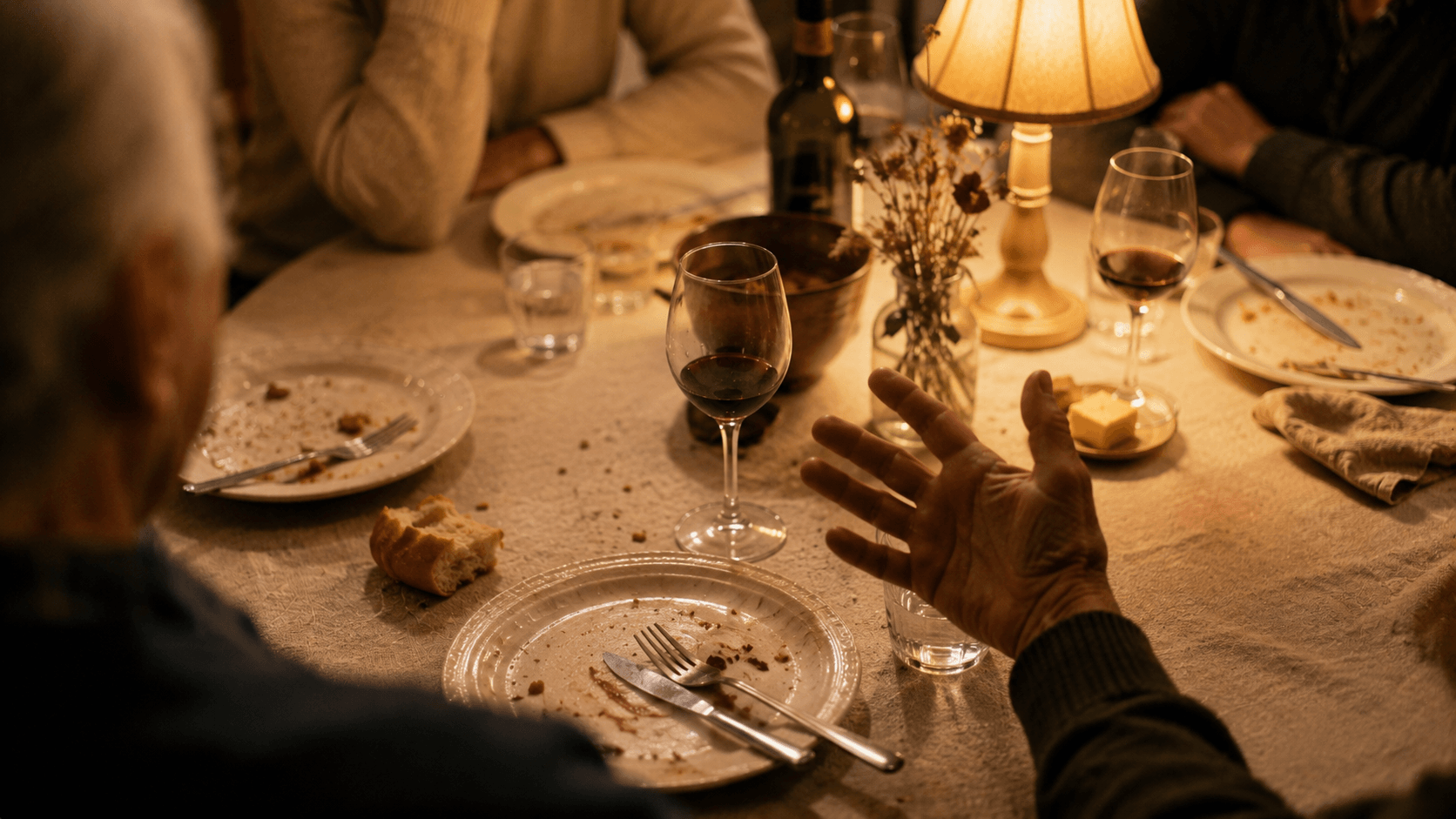
Most of us know someone who can tell a story. The relative at a dinner table who can take a room somewhere. The friend whose anecdotes you find yourself repeating, badly, the following week. The aunt who arrives at Christmas and within an hour has you all leaning forward, glasses untouched, waiting for the next thing.
We tend to treat this as a personality trait. Some people are gifted with it. The rest of us listen.
That is not quite right. What looks like a gift, examined closely, turns out to be a set of habits. About what to notice. About what to put first. About what to leave out. These are skills, not character traits, and they can be learned. They apply to the page and they apply to the spoken word equally well. They apply to the toast at a wedding, to the story you tell your children about your grandfather, to the answer you give when someone asks what your mother was like. They apply, in particular, to writing about your own life with the time and care it deserves.
This piece sits on the Biography Studio blog, so a brief word about what that is. Biography Studio is a guided service that helps people record their own life story. You work through a sequence of questions across the chapters of a life, in your own words and at your own pace, and at the end you receive a beautifully made hardback book. Doing that well means telling stories well, one answer at a time. So the principles in this piece are the ones our customers use to bring their answers to life. But they are general skills, and they belong to anyone who wants to do better justice to the moments of their own life, whether on a page, at a dinner table, or in the way they talk to the people they love. You do not need to be writing a book to want to tell a story properly.
The cognitive side of how memory itself works, and why specific cues unlock the detail that good stories live on, is covered in How Memory Works. This piece sits alongside that one. It is about what to do once the memory has surfaced. How to handle it so that the texture survives the telling.
The instinct most people start with
When people try to tell a story about their own life, whether describing a parent, recounting a holiday, talking about the place they grew up, writing a memoir or giving a toast, the first thing they reach for is a summary. My grandmother was a kind woman. She loved her garden. Everyone in the family adored her. Three sentences that say almost nothing, because they would say the same thing about half the grandmothers in the country.
The instinct comes from somewhere reasonable. You are trying to be efficient. You are trying to be fair to a complicated person, and you do not want to reduce her to one story. So you generalise. You list her qualities. You give your listener what you think they need, which is an overall impression.
The listener does not want an overall impression. The listener wants to meet her.
The American writer Vivian Gornick made a useful distinction in her book on writing personal narrative. Every piece of personal storytelling, she said, has two things. The situation, which is what happened. And the story, which is what the teller makes of what happened. The summary is the situation. The story is what you are reaching for. The four moves below are how you get there.
Lead with the senses, not the facts
The first habit of a good storyteller is to start with something the body remembers, not something the mind has filed away.
When you are asked about the first house you remember, the instinct is to begin with the address. The street. The year you moved in. These are facts and they belong somewhere in the telling, but they do not belong at the start, because your listener cannot feel them. Facts orient. They do not transport.
Start with what you saw. The pattern on the hallway carpet. The colour of the front door from the inside. Start with what you heard. The sound the letterbox made. The way the floorboards on the landing creaked, and which one was loudest. Start with what you smelled. The kitchen on a Sunday. The wax on the dining room table. The dog. These are the details that were stored alongside the memory at the time it was formed, and they are what let your listener stand inside it now.
This is true for places, and it is also true for people. The smell of a grandmother’s house. The sound of her voice on the telephone. The particular feel of her hand when she took yours. These details unlock something a list of her qualities cannot. The body knew her before the mind described her.
There is a practical reason this works on the page, and the same reason it works at a dinner table. Specific sensory detail is harder to fake and easier to picture. She was warm could be said about anyone. She always had a tea towel over one shoulder belongs to a particular person in a particular kitchen.
Lead with the senses. The facts can come behind.
Find the moment, not the period
The second habit is to talk about one occasion, not a stretch of time.
The instinct, when you are asked about your grandmother, is to give a summary of what she was like across decades. Every Sunday we would go to her house. She would make a roast. She would have biscuits in a tin. You are describing a pattern, which is what the brain hands you first, because patterns are how it stores repeated experience. But a pattern is, by definition, a generalisation. The specific Sunday gets folded into all the others.
The richer version is to find one Sunday. Not the most important one. Often not even a particularly memorable one. Just a specific occasion you can return to. The Sunday she taught me to peel an apple in one long ribbon. The Sunday she fell asleep in her chair before the pudding came out. The Sunday my brother knocked over the gravy boat and she laughed so hard she had to leave the room.
A single scene has time and place and other people in it. It has a beginning and an end. It has weather, and a particular light, and a particular smell from the kitchen. A summary has none of these things, because it is a composite. The single scene is where your listener stands beside you. The summary is where they stand outside.
You can still mention, somewhere in the telling, that this was one of many Sundays. You can compress the pattern in a sentence. We went every week for as long as I can remember. That sentence does its work in fifteen words. The scene that follows is where the story earns its place in the room.
Reveal people through what they did, not what you call them
The third habit is the one that does the heaviest lifting. It is also the one most people resist, because it feels indirect.
Adjectives are not how people are revealed. Kind. Strict. Funny. Generous. These words tell your listener what category to file the person in, but they do not let them meet her. They are labels, and labels are the cheapest currency in writing or speaking about a life.
People are revealed through their behaviour. The thing they did every time. The thing they said when they were tired. The particular way they laughed. The object they always had in their hand. The phrase that, if you say it aloud now, you can hear in their voice.
She kept a tin of shortbread in the cupboard above the kettle and you were never allowed to leave without one. That sentence does more work than ten adjectives. Your listener has met her. They know what kind of woman she was, what kind of household it was, what kind of welcome she offered. None of it had to be named.
This applies to contradictions, which is usually where someone is most themselves. People are not consistent. They are warm and impatient. They are generous and sharp-tongued. They love you and they criticise you in the same breath. The instinct, when describing someone, is to choose one side and present a clean version. The truer move is to show both, side by side, in the same scene. She would tell off the dog and slip it a biscuit in the same minute. The contradiction is who she was. The label was always going to lose information.
The test is straightforward. If a sentence about someone you loved could be said about anyone else’s grandmother, mother, or friend, it is not yet doing its job. Find the detail that belongs only to her.
Leave things out
The fourth habit is the one storytellers practise hardest. It is the discipline of constraint.
When you are talking about someone important, the instinct is to put everything you remember about them into one telling. You have decades of memories. You loved her. You want your listener to understand the whole of her. So the telling sprawls. It tries to cover her life, her character, her relationships, her changes over time. By the time it is finished, it has said a great deal and conveyed almost nothing.
A good storyteller knows that two well-chosen details do more than twenty general ones. They trust the listener to fill in the rest. They know that the right small thing implies the larger thing it sits inside.
This requires faith in selection. It requires deciding that one Sunday, told well, will say more about your grandmother than a paragraph trying to summarise her. It requires resisting the urge to add. When in doubt, cut. The instinct to add is almost always wrong. The instinct to leave space is almost always right.
This becomes particularly important when you are working through a structured framework rather than telling a single story. In a Biography Studio project, your father might first come up in the Foundations chapter, which covers your home life from birth to twelve. The temptation is to write the whole of him into that first answer. He was your father for half a century. You have a great deal to say.
Resist it. He will appear again. In the chapters on your teenage years and early adulthood. In the moments that turned out to matter. In the questions on the people who shaped you. In the chapter on what you wish you had said before he died. Each time he appears, he can carry a different facet. Use the architecture. Let the Foundations answer be about the father you knew when you were six, and trust the framework to give you the rest of him later.
The same principle applies when there is no framework. There will be other dinners. There will be other times to tell another story about him. The one you are telling now does not have to do everything.
The craft you grow into
What these four habits add up to is not a formula. It is closer to a practice. They get easier with use. The first time you try them, you will, in places, fall back into summary, into adjective, into the temptation to cover everything. By the third or fourth time, the moves will have started to feel natural. You will catch yourself, mid-sentence, reaching for an abstraction, and you will replace it with a detail. You will be partway through a story at a dinner table, notice that you are listing qualities, and switch into a scene.
This is what the storyteller-relative has done, without knowing it, across years of telling. They have learned to start with the thing the room can picture. They have learned to give one moment its full weight rather than three moments their thin one. They have learned that the small particular detail is what makes a story land.
You are not learning to be a writer. You are learning to do better justice to the moments of your own life when you talk about them. The work pays off everywhere. At the table, in the toast, in the letter, in the page. And if you ever sit down to record your life properly, in the structured way Biography Studio is designed for, the same habits will serve you, one question at a time.
The series continues with three further pieces, each one applying these habits to a specific kind of memory. How to write about a place you remember. How to write about someone you loved. How to write about a moment that mattered. They sit alongside this one as the practical companions to the principles. [Links to be added once the spokes are published.]
A story told well is a small act of generosity. The listener gets to stand somewhere they would not otherwise get to. The person you are talking about gets a fuller version of themselves into the world. And you, in the telling, get to feel the weight of what you have lived. These habits are how that happens.
Biography Studio guides you through your life story across thirteen chapters, in your own words, at your own pace. The framework is built. The questions are ready. All that remains is to find a quiet half hour and begin.
How do I start telling a story about a memory?
Begin with something the body remembers rather than something the mind has filed away. The colour, the smell, the sound. Sensory detail unlocks the rest of the memory and lets your listener stand inside the scene with you.
What makes a good description of a person, in writing or in conversation?
Behaviour, not adjectives. A recurring gesture, a phrase they always said, an object they always carried. The specific things they did reveal who they were in a way that labels like kind or funny never quite manage.
Do I need to be a good writer to tell stories well?
No. The work is in noticing and selecting, not in literary technique. The skills are about what to put first, what to dwell on, and what to leave out. They apply to speech as much as to the page. They grow quickly with practice.