
From the founder of Biography Studio
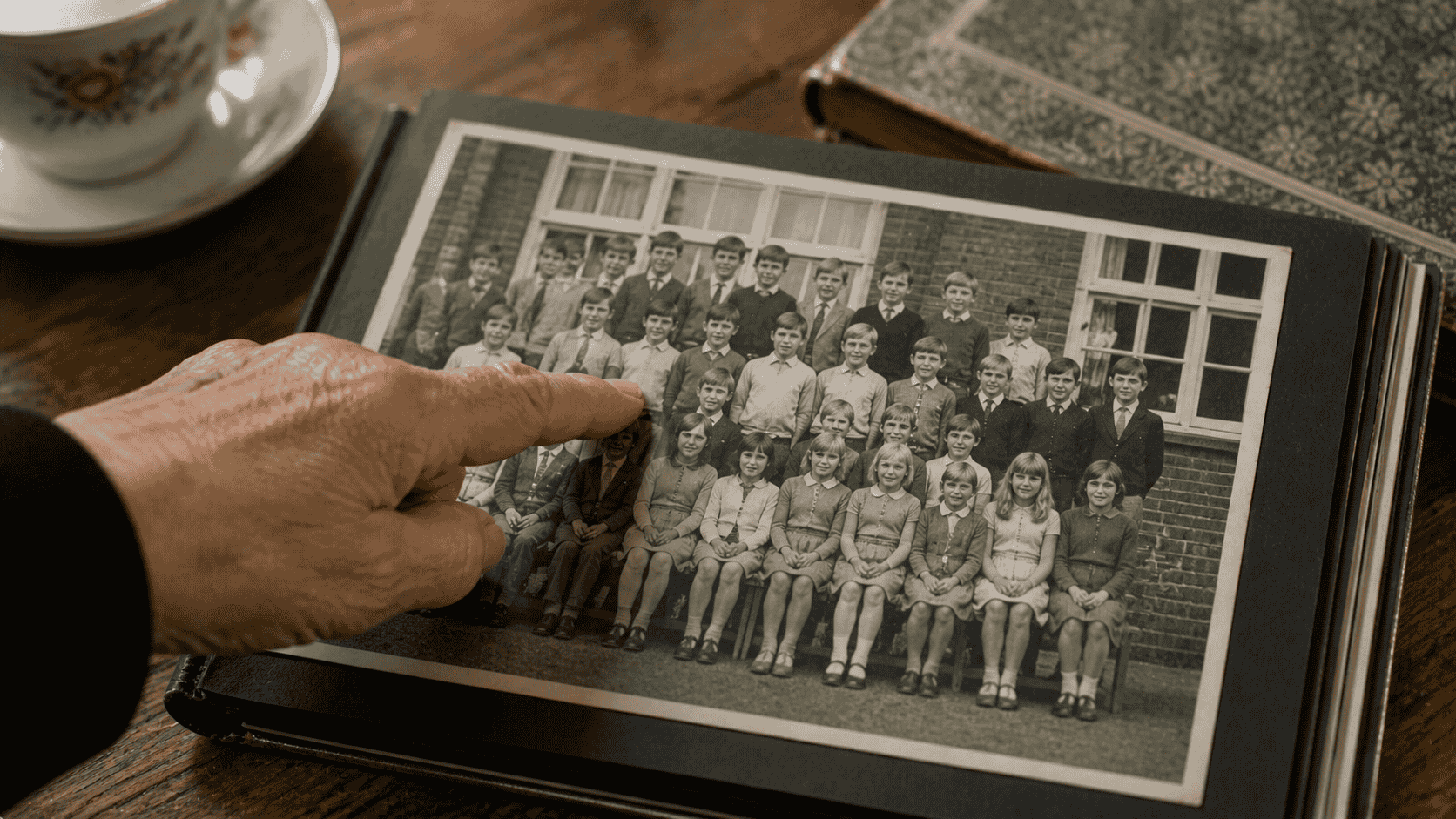
A few years ago I went to a school reunion. Twenty-five years since I had last seen most of the people in the room. Some of them I had not thought about, in any meaningful way, since the day I left. They were people I had spent years sitting next to, eating lunch with, walking to lessons with, and they had vanished from my mind so completely I could not have produced their names if my life had depended on it.
I had a drink in my hand and I was talking to someone whose face I half-recognised when another man came over and started telling a story about a chemistry teacher we had all had. Mr Bartlett. I had not thought about Mr Bartlett in twenty-five years. As soon as the name was said, he was there. The yellow tie he wore. The way he stood at the front of the lab with his hands behind his back. The particular smell of that classroom on a hot afternoon when the gas taps had been left on too long. A whole world, instantly returned, that ten seconds earlier I would have sworn was gone.
This kept happening all evening. Someone would mention a corridor, a particular morning assembly, a friend of a friend, and another door would open. By the time I drove home I had a head full of material I had not known I still had. Names I had not used in a quarter of a century. The geography of a building I had not set foot in for longer. The sound of a particular bell. Things that, the day before, I would have told you with confidence were lost.
What I want to talk about in this piece is what was actually happening in my brain that night. Because once you understand it, something becomes obvious about how memory works that has practical consequences for anyone who wants to record their own life. Most of what you remember is not gone. It is unreached.
The layered structure of memory
The most influential model of how autobiographical memory is organised was developed by the British psychologist Martin Conway, working with Christopher Pleydell-Pearce, and published in 2000. Their model, the self-memory system, has been the dominant framework in the field for the last twenty-five years, and the part of it most relevant here is its account of how memories are stored.
Conway’s central insight was that autobiographical memory is not a single uniform archive. It is hierarchical, organised in three layers of increasing specificity.
At the top sit lifetime periods. Broad, themed phases of life. My time at primary school. When I was first married. The years I lived in London. These are not memories in the usual sense. They are general knowledge about a chunk of your own life. If you try to think about a lifetime period directly, what comes back is a feeling, a vague impression, perhaps a fragmentary image. It is real, but it is the surface of the lake.
Beneath sit general events. The patterns of a life. The things that happened repeatedly and got compressed, by the brain, into a representative version. Sunday lunches at my grandparents’. The drive to school. Holidays in Cornwall. These are richer than lifetime periods, but they are still composites. The Sunday lunch you remember is not really one lunch. It is a kind of average of all of them, with the recurring features preserved and the specific occasions blurred.
Beneath those sit event-specific memories. Single moments, tied to a particular time and place, complete with the sensory detail that makes them vivid. The Sunday my grandfather laughed so hard at something my brother said that he had to put his fork down. The morning I crested the hill on the drive into Cornwall and saw the sea for the first time that summer. The afternoon Mr Bartlett’s gas taps had been left on.
This is where the texture of a life lives. The smells, the voices, the specific light on a specific afternoon. And it is also the layer that casual reflection rarely reaches.
The reason is straightforward. When you ask yourself a general question about your own past, what was secondary school like?, your brain does not descend through the hierarchy. It hands you the top layer. A general feeling, a vague impression, perhaps a single iconic image that has come to stand for the whole period. That is the material the surface layer is designed to deliver. It is fast, it is efficient, and it is almost always insufficient.
To reach the layer beneath, you need a different kind of input. You need a cue.
The role of the cue
Endel Tulving, the psychologist who did more than anyone to map the architecture of human memory, established a principle in the early 1970s called encoding specificity. The principle, in plain language, is this: a memory is most likely to surface when the conditions of recall match the conditions in which the memory was first formed. The closer the match, the better the recall.
A vague prompt produces a vague response because it does not match the specifics of any particular memory closely enough to activate it. A specific cue, one that overlaps in some distinctive way with the original encoding, can reach down into the hierarchy and pull a single moment back into consciousness, complete with the detail that was stored alongside it.
This is what was happening at my school reunion. The mention of Mr Bartlett’s name was a cue with a precise overlap. It matched a layer of stored experience that nothing else in my daily life had matched for twenty-five years. The match unlocked the memory, and unlocked everything stored alongside it. The yellow tie, the gas taps, the hot afternoon. None of that material was retrieved deliberately. It surfaced, all at once, because the right key had finally been turned in the right lock.
The Danish psychologist Dorthe Berntsen has spent the last thirty years studying exactly this phenomenon. Her research distinguishes between voluntary autobiographical memory, the kind you produce when you deliberately try to remember something, and involuntary autobiographical memory, the kind that surfaces unbidden in response to a cue. Her work, replicated many times since the 1990s, has shown that involuntary memories are remarkably common in everyday life. In one of her studies, she and a colleague asked participants to record every spontaneous autobiographical memory they experienced over the course of a day. The frequency of involuntary memories turned out to be more than twice that of the deliberately retrieved kind.
This is worth pausing on. Most of the memories that surface in your daily life are not the ones you summon. They are the ones triggered by something you have walked past, or glanced at, or heard in passing. The smell of someone else’s cooking through an open window. A song on the radio. A particular slant of light on a Tuesday afternoon in October. Berntsen’s research has shown that these triggers tend to share a common feature: they are distinctive enough to overlap with one specific memory and not many others.
This is the same principle as Tulving’s encoding specificity, observed in the wild. The more uniquely a cue maps onto the conditions of an original experience, the more reliably it produces a memory in response. A song you only ever heard one summer is a powerful cue. A song you have heard for decades is almost no cue at all, because it is associated with too much.
What both bodies of research point to, from different angles, is the same uncomfortable truth. The memories you can produce on demand are a tiny fraction of the memories you have. The vast majority sit beneath the surface, fully intact, waiting for a cue distinctive enough to call them up. Without that cue, they do not exist in any practically accessible sense. With it, they return in full.
The feeling of finding one
Anyone who has had the experience of bumping into someone from a forgotten part of their life knows what this feels like. You are walking down a street, going about an ordinary afternoon, and a face turns toward you that you have not seen in thirty years. For a fraction of a second nothing happens. Then the name surfaces, and behind the name comes a whole world. The classroom. The other children who sat near them. The teacher you had at the time. The walk home, the houses on the route, the dog one of those houses had. None of this material was accessible five seconds earlier. None of it would have come back if you had sat down and tried. But the cue, the specific face of one specific person, has reached down through the hierarchy and pulled an entire layer of stored experience into the light.
There is a particular emotional quality to this kind of retrieval that the research literature does not quite capture but anyone who has experienced it knows. A small lift. A brightness. The feeling that the day has just got bigger. You walk on for the next hour with a head full of material that was not there before, and some of it stays with you. The chance encounter has not just produced a single memory. It has dragged a whole region of your past back into your active life, and from that point on it is part of you again in a way it had stopped being.
This is the experience of having one cue, by accident, reach into one part of your life. Now imagine doing it deliberately, across the whole of it. Imagine being given a sequence of cues precise enough to do this work for every chapter of your life. Your earliest home. The street you played on. The people who lived next door. Your first day at school. The teachers who mattered, the ones who did not, the friends you made, the friends you lost. The years you cannot quite locate in time but know shaped you. The relationships that ended, the ones that did not, the moments that turned out, in retrospect, to have been turning points.
Most people never get to do this. The cues are not available. Daily life does not provide them. And the layered structure of memory means that without a cue, the material stays where it is, accessible in principle but unreached in practice. A great many of the things you have lived through are stored in your brain, in full, and you will go to your grave without thinking about most of them. Not because they are gone. Because nothing has ever asked you the right question.
The notebook in the head
There is one more piece of the picture worth understanding, because it has practical consequences for how to do this work well.
Memory researchers have consistently found that the brain continues to process material long after conscious attention has moved on. A question you read on a Monday and return to on Wednesday will often produce a noticeably richer answer than one you tried to answer on Monday afternoon. The brain works on it in the background. Names surface. Details return. Associated memories reach the threshold of awareness and become available for recall in a way they were not when the question was first asked.
You know this from ordinary life. The forgotten word that arrives in the shower. The argument you replay two days later and finally know what you should have said. The face whose name you could not produce at the dinner party but which surfaces, unbidden, while you are brushing your teeth at midnight. The brain is always running search queries on its own knowledge base. Some of them just take a while to return.
This means the most effective way to access your own memory is not to sit down and try to remember. It is to read a question, sit with it, and let your brain find the material in its own time. Carry a notebook. Write things down as they come, in the shower, on a walk, in the supermarket queue, in the middle of the night. The richest answers are almost never the ones produced on first reading. They are the ones that surface across the days that follow, once the cue has had time to do its work and the deeper layers have begun to release what they hold.
I have written more about that practical side of things here. The reason it works is everything described above. The cue has reached the layer where the detail lives. The detail is now coming up, slowly, from where it has been waiting. Your job is to be ready when it arrives.
Why this matters for Biography Studio
Biography Studio is, at the most basic level, a question framework. Thirteen chapters, each containing dozens of questions, designed to take you through a whole life in sequence. There are countless ways such a thing could be built. The questions could be broad, comfortable, easy to answer. The framework could move quickly, hand you a generic prompt for each lifetime period, and produce a serviceable summary of who you are.
The reason it is not built that way is everything described in this piece. A broad question hands you the surface layer. A specific question reaches the layer beneath. The architecture of memory rewards precision, and a question framework designed to produce a real biography rather than a generic one has to be designed accordingly.
When the questions ask about a particular house, a particular teacher, a particular summer, they are not being arbitrary. They are functioning as cues, in exactly the technical sense that Tulving and Berntsen and Conway describe. They are designed to overlap distinctively with stored experience and to reach the layers where the texture of a life is held.
What this means in practice is something I hear from customers more than anything else. I have not thought about that in fifty years. I had completely forgotten about her. I cannot believe how much has come back. The school reunion experience, deliberate, sustained, applied to a whole life rather than one evening. Names surfacing that have not surfaced in decades. Sensory detail that had been folded away and is now back in active circulation. Memories of people, particularly people who have died, suddenly vivid in a way they have not been since the person was alive.
There is a real lift to this. The same lift you get from a chance encounter on a street, but spread out over months and applied across the whole arc of a life. People who go through the process tend to describe it not as work but as a kind of accompanied excavation, with the questions doing the heavy lifting and the memories doing what memories do once the right cue has reached them. They emerge from it carrying material they did not know they still had. And they have, in a hardback book, a record of all of it.
The book is the artefact. The retrieval is the gift.
There is a lot of life stored in your head that you will never think about again unless something asks the right question. Biography Studio is the something. The framework was built to give you, deliberately and across your whole life, the experience of having that material come back.
That is what the questions are for. That is why they look the way they look. And that is why people come out of the process saying it changed something they did not know was changeable.
Biography Studio guides you through your life story across thirteen chapters, in your own words, at your own pace. The questions are designed to take you somewhere most people never get to go. Let them.
Why do I remember some things vividly and forget others?
Memory is organised hierarchically. Specific moments tied to time and place are stored at the deepest layer, complete with sensory detail. Casual reflection rarely reaches that layer, which is why we forget so much without specific cues to retrieve it.
Can I really remember things I have forgotten?
Yes. Most memories are not lost, they are unreached. Research by Dorthe Berntsen has shown that involuntary memories triggered by specific cues are more than twice as common as deliberately retrieved memories.
What is the best way to recall old memories?
Specific cues work better than general questions. Asking yourself about a particular house, teacher, or summer will return material that asking about your childhood in general will not. Giving the question time also helps, the brain continues to surface details over hours and days after the question is first asked.