From the founder of Biography Studio
In brief
- Biography Studio is built on ethnographic research methods developed over decades in academic social science
- The question framework draws on established principles of how autobiographical memory is stored and retrieved
- Structured life review, the process at the heart of every Biography Studio project, has documented benefits for psychological wellbeing and life satisfaction
- Narrative identity research shows that articulating a life story is not just an act of recording but an act of meaning-making that changes how a person understands themselves
Biography Studio is not a technology product that happened to choose life stories as its subject matter. It is a research-based framework that happens to be delivered through a digital platform. The distinction matters, and this piece is about why.
Where it comes from
I have always loved a good story. I grew up in a family of storytellers, people who could make the ordinary vivid and the distant feel present. My grandfather died before I was born, but I knew him, in the way you can only know someone through the stories of people who loved them. The details were specific enough, the anecdotes funny enough, the character consistent enough, that he became real to me. That is what a good story does.
I suspect that is partly why I gravitated toward ethnography. The academic discipline concerned with how people construct meaning from their lives and their social worlds seemed, to me, like a formalised version of what the best storytellers in my family had always done instinctively: ask the right questions, listen properly, and let the person in front of you show you who they were.
I spent years in field research, conducting structured interviews with people about identity: how they understood themselves, how they situated themselves within their culture and community, how they made sense of who they were and where they had come from.
That work is grounded in a theoretical tradition that draws on identity studies, narrative theory, and qualitative social science. A tradition that takes seriously the idea that identity is not fixed or given but constructed, and that the stories people tell about themselves are the primary mechanism by which that construction happens. Who we are is not something we simply are. It is something we make sense of, continuously, through the narratives we build around our experience.
What field research teaches you, more than anything, is the power of the question. Not the survey question, which extracts data. The ethnographic question, which opens a door. The difference between “did you feel connected to your community?” and “tell me about the last time you felt you truly belonged somewhere” is not a difference in wording. It is a difference in what becomes possible. The right question, asked with enough precision and enough openness, can surface something a person has never articulated before, even to themselves.
Biography Studio was built on that insight.
The ethnographic method
Ethnographers do not ask people to tell them about their lives in general. They ask specific, contextual questions designed to move through the layers of experience in a sequence that builds understanding gradually. Each question narrows the focus to a particular moment, a particular person, a particular place, while remaining open enough to allow what was not anticipated to emerge.
This is the architecture of the Biography Studio question framework. Each chapter covers a defined territory of a life. The questions within it move from the broad to the specific, from the factual to the reflective, from what happened to what it meant. The sequence matters. Foundations before identity. Identity before relationships. Experience before meaning. This is not an arbitrary organisation. It mirrors the sequence that ethnographers use to build a complete life history, establishing the context first and reaching for interpretation only once the material is present to interpret.
The other principle the framework borrows from ethnographic practice is that the quality of what surfaces is directly determined by the quality of the question. Vague prompts produce vague impressions. Specific questions, ones that ask for a particular house, a particular teacher, a particular summer, produce something more granular and more truthful. They give the person something precise to reach for, which is what allows them to reach past the surface layer of memory into the material that is actually worth capturing.
How autobiographical memory works
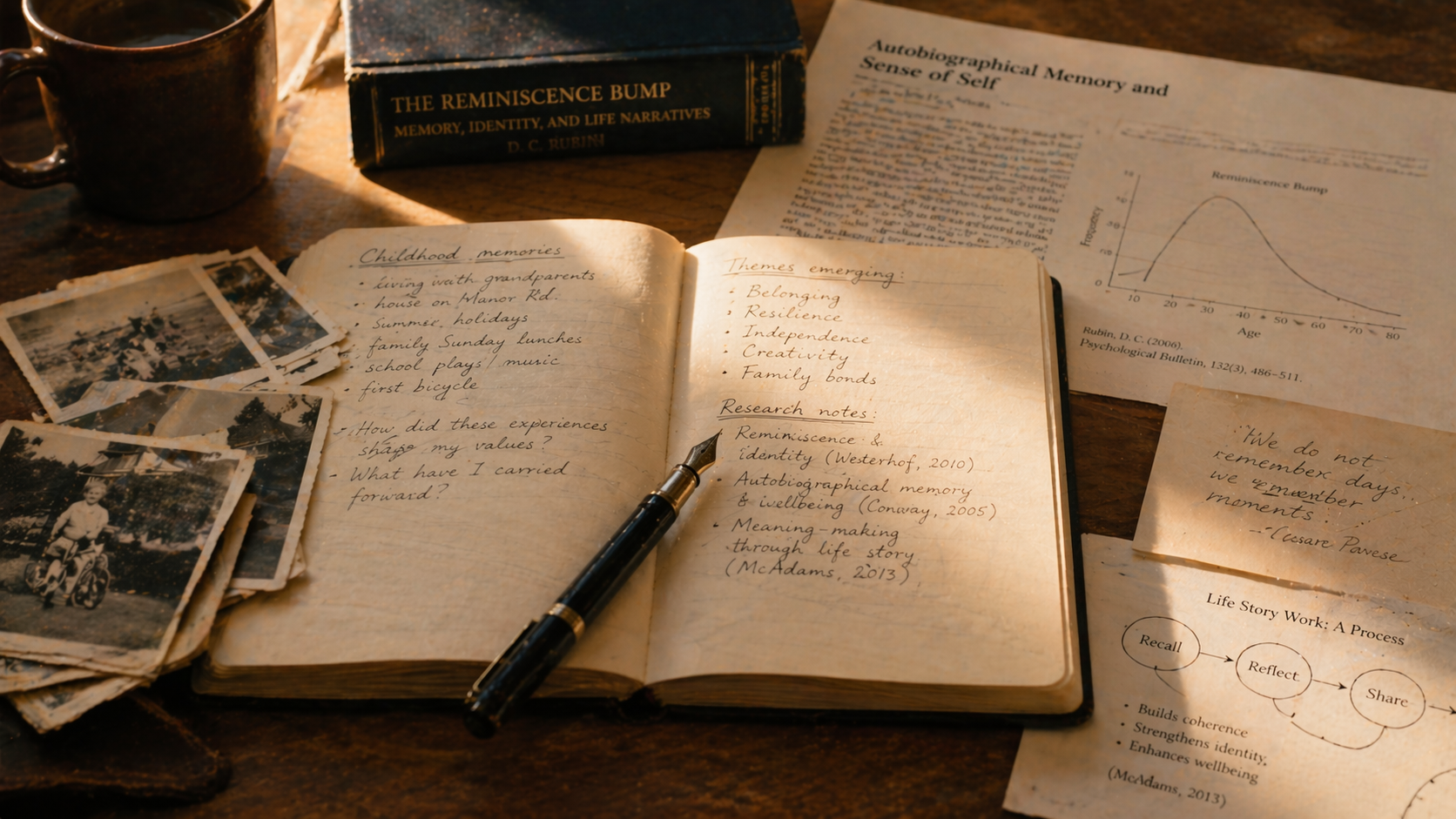
Memory researchers have consistently found that autobiographical memory is not stored as a set of complete, retrievable scenes. It is organised hierarchically, in layers of increasing specificity.
At the top are lifetime periods: broad phases of life, associated with a general feeling rather than a particular event. Ask someone to think about their childhood and what comes back is usually a vague impression, a fragmentary image, an emotional tone. This is the surface layer.
Beneath it are general events: the things that happened repeatedly, the patterns of a life. The Sunday rituals. The annual holidays. The recurring dynamics of a family.
Beneath those are specific memories: single moments, tied to a particular time and place, complete with the sensory detail that makes them vivid. This is where the richest material lives. It is also the layer that casual reflection rarely reaches.
The principle of encoding specificity, established in memory research and consistently supported since, holds that the more precisely a retrieval cue matches the conditions of the original experience, the more detail is recovered. A question that asks for a specific house, a specific smell, a specific voice is a far more effective retrieval cue than a general invitation to remember. This is why the Biography Studio questions are written the way they are. They are not prompts. They are cues, designed to reach the episodic layer where the detail is stored.
Research has also consistently found that sensory cues, music in particular, unlock memories with a quality and richness that verbal cues alone cannot produce. And that memory given time to incubate, returned to after a pause rather than answered immediately, produces richer and more complete material than memory accessed on demand. Both of these findings are built into how Biography Studio recommends its users approach the questions.
Structured life review and wellbeing
The process at the heart of a Biography Studio project, going back through a whole life, stage by stage, with specific questions at each stage, has a name in academic research. It is called structured life review, and it has been studied extensively.
Researchers who study wellbeing in later life have consistently found that structured life review produces measurable improvements in life satisfaction, psychological wellbeing, and sense of meaning. The effect is not trivial. Multiple meta-analyses, synthesising the results of dozens of controlled studies, have found moderate to large effect sizes for structured life review on psychological wellbeing outcomes. Critically, the research distinguishes between simple reminiscing, which produces some benefit, and structured review, which produces significantly more. The structure matters. The sequence matters. The specificity of the questions matters.
The theoretical framework underlying this research was developed most influentially by the psychologist Erik Erikson, whose model of human development identified a final stage beginning in later adulthood in which the central developmental task is exactly what Biography Studio is built to support: making sense of a whole life. Erikson called the positive resolution of this stage integrity, a sense that the life was coherent, that it meant something, that it was worth having. The route to integrity, in his framework, is not circumstance or luck. It is the willingness to look back at everything, clearly and without flinching, and find the meaning that was there.
Biography Studio is, structurally, a supported process for doing that. Thirteen chapters. A whole life. Every stage given its proper weight.
Narrative identity
The psychologist Dan McAdams, one of the most influential researchers in personality and lifespan development, has spent decades studying what he calls narrative identity: the internalized and evolving life story that people construct to give their lives a sense of unity and purpose.
McAdams’s central argument is that modern adults give their lives meaning by constructing and internalising self-defining stories, what he calls personal myths. These are not passive records of what happened. They are active constructions, shaped and reshaped throughout life, that determine how a person understands who they are and where they are going.
The research that has followed from this framework has found consistently that the stories people tell about their lives have measurable consequences for their wellbeing. People who construct life narratives featuring themes of agency, exploration, and what McAdams calls redemptive meaning, the sense that difficult experiences led to growth or understanding, tend to enjoy higher levels of mental health, psychological maturity, and life satisfaction than those who do not.
The implication is significant. Articulating a life story is not just an act of recording. It is an act of meaning-making. The process of putting a life into words, of deciding what to include and how to frame it, changes how the person understands their own experience. Biography Studio does not simply capture a life. It helps a person construct the narrative through which they understand it.
The research on narrative identity is compelling. What is less often acknowledged is how rarely most people get the opportunity to actually do this work.
Constructing a coherent life narrative is not something that happens automatically. It requires time, structure, and the right questions to draw out material that daily life keeps buried. For most people, the only contexts in which this kind of structured self-reflection happens are academic, therapeutic, or crisis-driven. A research interview. A period of counselling. A moment of serious illness that forces a reckoning with what has and has not been lived.
The rest of life tends to prevent it. We are too close to our own experience, too busy managing the immediate, too immersed in the day-to-day demands of work and family and simply getting through. The sweep of a life, the full arc of it from the earliest memories to the present day, is almost never visible from inside it.
Biography Studio was built to change that. The framework exists to give people the structure and the questions that make this kind of reflection possible outside of an academic or clinical setting. A whole life examined in sequence. The cast of characters, the places, the turning points, the values, the meaning. Not as therapy and not as research, but as something a person can do for themselves, at their own pace, because their life is worth that kind of attention.
The oral history tradition
Biography Studio also sits within a longer tradition than academic psychology: the tradition of oral history and life story work, which has been treating ordinary lives as historically and humanly significant for more than a century.
The oral historian Studs Terkel spent his career doing what Biography Studio does in a different form: asking precise, generous questions of ordinary people and discovering that every life, examined with sufficient care and the right questions, produces material of extraordinary richness. The Mass Observation project in Britain, which from 1937 onwards collected the diaries and testimony of ordinary citizens as a record of lived experience, rested on the same conviction: that the daily texture of an ordinary life is not mundane, it is irreplaceable.
The academic discipline of oral history has developed, over that same period, a sophisticated methodology for eliciting and preserving life testimony. Its central finding, arrived at through decades of practice, is that the interview is not a neutral instrument. The quality of what emerges is determined by the quality of the questions, the sequence in which they are asked, and the relationship of trust that makes genuine disclosure possible. Biography Studio borrows directly from that methodology.
But oral history matters for reasons that go beyond methodology or academic record. Stories are how families stay connected across time. They are how people who never met become real to those who come after them. I mentioned at the start of this piece that I grew up knowing my grandfather through stories, despite the fact that he died before I was born. That is not a small thing. It is, in many ways, everything. The specific details, the recurring characters, the funny anecdotes told the same way every time, these are the threads that knit a family together across generations. They are how the people we never knew become part of who we are.
A Biography Studio project does this work deliberately and permanently. It does not just record one person’s life. It preserves the entire cast of characters within it: the grandparent who loomed large, the friend who was present at every significant moment, the parent seen clearly for the first time as a person rather than a role. Every answer is also, quietly, a portrait of someone else. Every chapter adds to a record that will matter to people who have not yet been born.
Why it all converges
Ethnography, memory research, life review, narrative identity theory, oral history. These are not separate bodies of knowledge that happen to be relevant to Biography Studio. They converge on the same conclusion from different directions.
Memory is layered, and specific questions reach the layers that matter. Structured reflection on a whole life produces wellbeing outcomes that casual reminiscing does not. The stories people tell about their lives are the mechanism by which they construct meaning and identity. Ordinary lives, examined with care and the right questions, produce material that is anything but ordinary.
Biography Studio was designed at the intersection of all of this. The questions are not prompts. They are instruments, built on an understanding of how memory works, how identity is constructed, and what happens when a person is given the structure and the space to look back at everything they have lived through.
The book at the end is the record of what those instruments uncovered.
Biography Studio guides you through your life story across thirteen chapters, in your own words, at your own pace. The framework is the result of years of research. The story is entirely yours.