From the founder of Biography Studio
There comes a point for many of us when we realise we know much less about our parents than we thought. We know the outline. We have heard the same handful of stories told the same handful of ways. But the texture of who they were before we existed, the years that shaped them, the people who mattered to them, the things they believed and what they made of their lives, most of that sits in their heads and nowhere else. And one day, it will not even sit there.
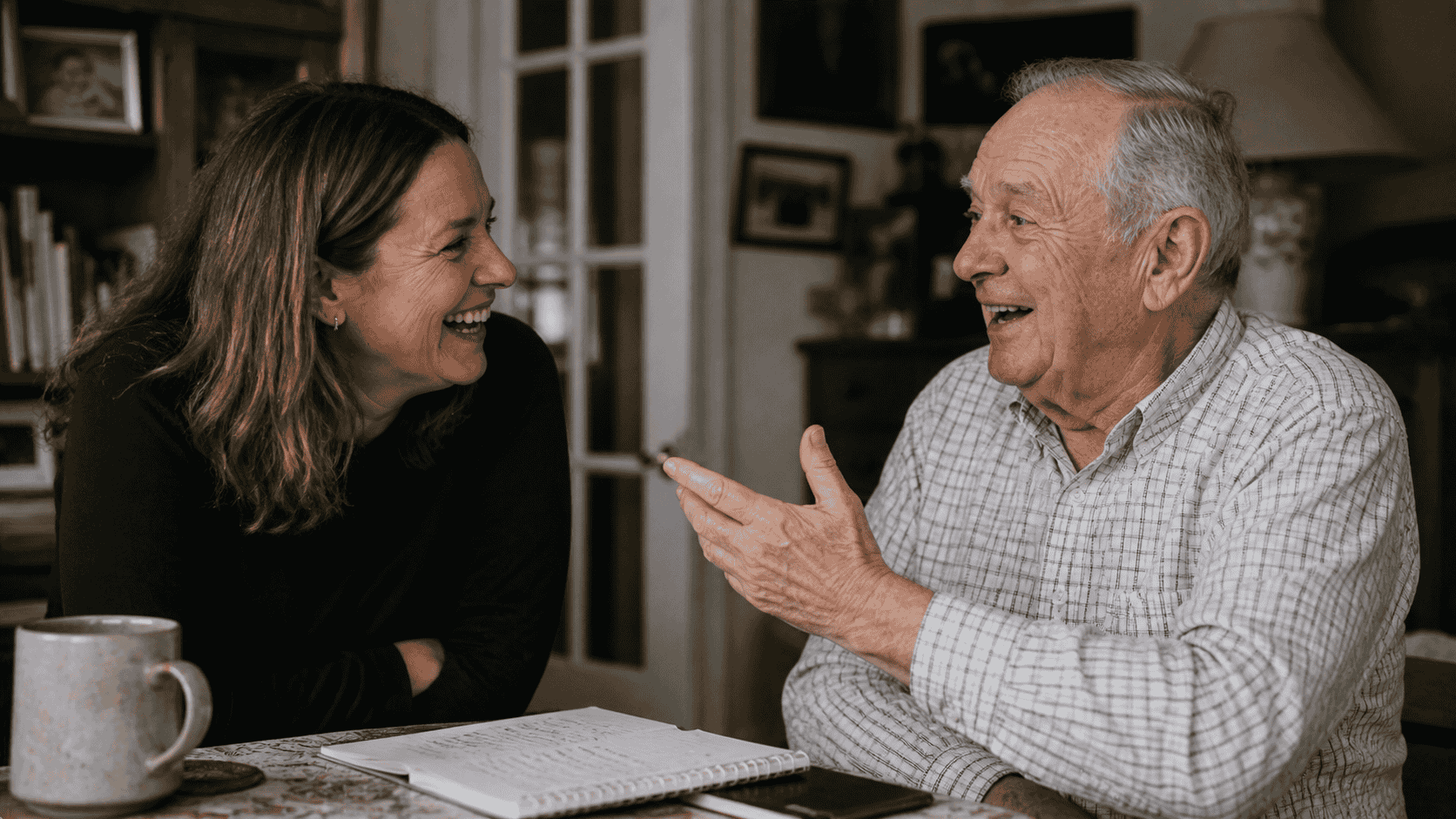
This piece is for anyone who has begun to feel the weight of that, and who is looking for the right questions to ask their parents about their life before the moment slips away. Below you will find 25 questions you can use as they are, organised into four broad areas of a life. After the questions, I want to talk about something more important than any individual question, which is how to think about the conversation you are about to have, and what makes the difference between an answer that is forgotten by the weekend and an answer that becomes part of how you understand the person you are speaking to.
The questions are below. You can use them as they are.
Childhood and where they came from
- What is the earliest memory you can still see clearly?
- What did the house you grew up in actually look and feel like, room by room?
- Who lived on your street, and who do you remember most vividly?
- What did you do on a typical Saturday as a child?
- What was your relationship with your own parents like at the time, before you understood it the way you do now?
- What was the first time you remember feeling proud of yourself?
Family and the people who shaped them
- Tell me about your grandparents. What were they like as people, not as relatives?
- Who in the family was the one everyone listened to, and who was the one who quietly held it all together?
- Was there someone outside the family, a teacher, a neighbour, an early boss, who shaped you in a way that lasted?
- What is a story about my other parent that I have never heard?
- What did your parents argue about, and what did they never talk about?
- Who in the family did you lose, and what do you wish I knew about them?
Now: the person they have become
- What do you understand now that you wish you had understood at thirty?
- What is the best decision you ever made, and what made it the right one?
- Is there something you used to believe strongly that you no longer believe?
- What are you most proud of having done, and what are you most proud of having survived?
- What do you still want to do, and what have you made peace with not doing?
- If you could go back and have a conversation with yourself at twenty, what would you tell that person?
Holidays, music, and the ordinary days
- What was the soundtrack to your twenties? What songs take you straight back?
- What do you remember about the holidays we used to take, the ones we did every year without thinking about it?
- What did Sunday lunch actually look like in your house growing up, and what did it look like in ours?
- What food, that you cannot get anymore or never make anymore, do you miss?
- What was your favourite chair, your favourite walk, your favourite small daily ritual at different points in your life?
- What is a smell that takes you back somewhere specific?
- What is something we used to do as a family that you wish we still did?
If you would like a printable, properly designed version of these questions to take with you, you can download it [here].
That is the practical part of this piece. What follows is the part I think matters more.
Why these questions to ask your parents work, and others do not
The 25 questions above are not random. They were chosen using a small set of principles that I have learned, partly through years of academic field research and partly through building Biography Studio, which I will come to in a moment.
The first principle is that specific questions produce specific answers, and general questions produce general ones. What was your childhood like is a question that almost no one can answer well. The brain responds to it by handing back a vague impression, a feeling, perhaps a single iconic image that has come to stand in for an entire decade. What did the house you grew up in actually look and feel like, room by room is a question that reaches into a different layer of memory entirely. It demands precision, and in demanding precision it returns it. The kitchen comes back. The smell of the carpet on the stairs. The light in the front room on a Sunday afternoon. None of that material is accessible through the general question. All of it is accessible through the specific one. (If you want to understand more about why that is, the science of how memory is stored and retrieved is the subject of a separate piece here.)
The second principle is that the most interesting questions are the ones that ask the person to look at something they have not looked at in a long time. Not the rehearsed family stories. Not the anecdotes told the same way every Christmas. The questions that produce genuinely new material are the ones that go somewhere familiar memory has not been for years. Who lived on your street. What did your parents argue about, and what did they never talk about. These are questions that bypass the stories your parent already knows how to tell and reach the territory where they have not had to perform anything.
The third principle is that good questions ask for two things at once. Tell me about your grandparents. What were they like as people, not as relatives. The first half opens the door. The second half tells your parent what kind of answer you are interested in. Without it they may give you the conventional version, the relative version, the polite version. With it they understand you want to hear them as a person who knew other people, not as a child describing their elders. The shape of a question contains permission, and the more carefully you write it, the more permission it gives.
These principles are the ones that show up most often in the questions above. There are others. The principle that emotional questions work better when they are anchored to a concrete moment than when they are asked in the abstract. The principle that questions about other people often produce the most revealing answers about the person you are actually talking to. The principle that the right question, asked at the right moment in a sequence, can return material the same question would not have produced if asked first.
This is the level of attention that goes into the question library at the heart of Biography Studio. Every question, across every chapter, is there for a reason. But there is something else worth saying, which is that even a perfect question is only half the work.
Beyond the questions: what most people miss when they sit down with their parents
The questions above will get you somewhere real. Use them carefully and you will end up with material from your parent that you did not have before. But there is a step beyond the questions that almost no one thinks about until they try to do this themselves and find that the conversation drifts, or that the same stories keep coming up, or that they have ten pages of notes and no idea how to make sense of what is in them. The step is strategy.
Anthropologists and ethnographers, the academic disciplines that have spent the last hundred years working out how to interview a person about their life, do not begin by writing questions. They begin by thinking about the territory. What are the broad areas of this person’s life worth covering? What is the sequence in which it makes sense to cover them? Where are the turning points likely to be, and what kind of question will reach them? Which areas can be approached directly and which need to be approached sideways? They build a structure for the conversation before they decide what to ask. The questions come out of the structure, not the other way around.
This is the part you cannot get from a list of questions on the internet. A list of questions is an instrument. A structure is a framework. The questions in the list above will get you four broad areas of your parent’s biographical life, which is a real and worthwhile thing to capture. But it is a fraction of what is in there. If you wanted to do this properly, you would also want to think about:
- What they have lived through. Not just what happened to them, but what was happening in the world at the same time. The decades they came of age in. The events they remember watching unfold. The cultural and political backdrop against which their ordinary life played out. Most people’s understanding of their parents skips the historical context entirely, and yet the texture of a life is partly the texture of the times it was lived in.
- What they think. The values they hold. What they believe and what they have stopped believing. What they fear. What they are still curious about. What they think about how their life turned out and what they would do differently. These are the questions that produce the version of your parent that exists beyond their relationship to you.
- What they hope. Not in the sentimental sense. In the practical sense. What they want to happen in the time they have left. What they hope for the people they love. What they would like to be remembered for. What they would like passed on, and to whom.
Each of these is a territory with its own logic, its own kind of question, and its own place in a sensible sequence. We do not cover them in the list above because the list above is a starter. The full picture is much bigger, and the work of mapping it, of asking the right questions in the right order across all of these dimensions, is what separates an interesting afternoon’s conversation from a complete record of who someone was.
What to do with what they tell you
One last thing worth knowing. The single most common mistake people make when they sit down to do this with a parent is to write nothing down, or to scribble a few notes, or to record the conversation on a phone and never listen back to it. The interview happens, both parties feel something has been done, and within a year most of what was said has dissolved. If you are going to do this, the writing-down is not optional. It is most of the point.
Whatever method you choose, treat the answers as the thing you are creating, not as raw material for a future thing you will create later. Tomorrow’s energy is rarely better than today’s. If you record a conversation, transcribe it within the week. If you take notes, type them up that evening. The longer the gap between the conversation and the record, the more is lost, and what is lost cannot be recovered by going back and asking again, because the second telling is never the same as the first.
A note on what we do
I built Biography Studio because the work I have just described, mapping the territory, writing the questions, sequencing them properly, conducting the interview, capturing the answers, turning them into something coherent and readable and beautiful, is far more involved than most people realise when they first set out to do it. It is the kind of work that takes years to do well, and almost no one does it well for their own parents because life does not provide the structure or the time or the editorial layer that the work actually requires.
What we do is provide all of that. Your parent (or you, if this is for yourself) is guided through their entire life across thirteen chapters, with questions written for each stage by people who have spent years thinking about how memory works and what makes a question reach the layer where the real material lives. The answers are then shaped, by an editor, into clean readable prose that preserves your parent’s voice and every detail they have shared. At the end, you receive a hardback book.
If the questions above are as far as you want to go, they will serve you well, and what comes out of them will be more than you had before. If you want the full version of what we have just been talking about, with the structure, the question library, and the editorial layer all done for you, Biography Studio is built to do exactly that.
Either way, the most important thing is that the conversation happens. There is more in your parent’s head than you know, and there is less time than any of us think.
Biography Studio is a guided memoir service that helps people record their life story across thirteen chapters, in their own words, at their own pace. The framework is built on years of research. The story is entirely theirs.