From the founder of Biography Studio
You already know the stories are there. Your dad’s first job. The house your mum grew up in. The holiday that went wrong and became the one everyone still talks about. You have heard fragments over the years, half-told at the kitchen table or mentioned in passing on a long drive.
What you probably do not have is those stories written down. And what you may have noticed is that the window for hearing them is not as wide as it used to be.
Biography Studio was built to work as a solo project, one person sitting with the questions and their own memories. If that is you, we have written a practical guide to doing it on your own. But for many people, the best way to do it is together. Someone asks the questions. Someone else answers. And in the space between, stories surface that neither of you expected.
This is a guide to doing it that way.
Why people start
There is usually a moment. A retirement, a milestone birthday, grandchildren old enough to start asking questions about the old photographs. Clearing out a house and finding a box of letters that nobody has opened in thirty years.
The impulse is worth acting on. Maybe now just feels like the right time. Maybe a certain stage of life has brought a willingness to look back, to take stock, to lay things down in your own words before the details start to blur. Whatever the reason, the fact that you are thinking about it at all is the only prompt you need.
What changes when you do it together
There is a body of research, mostly in the field of reminiscence therapy, that helps explain why this works so well as a shared activity. Studies published in the International Journal of Geriatric Psychiatry and Ageing Research Reviews have found that structured recall of personal memories improves mood, reduces symptoms of depression, and strengthens an older person’s sense of identity and self-worth. A 2025 study in the Australasian Journal on Ageing found that older adults who shared their stories in an intergenerational setting reported a stronger sense of being understood and validated by those around them.
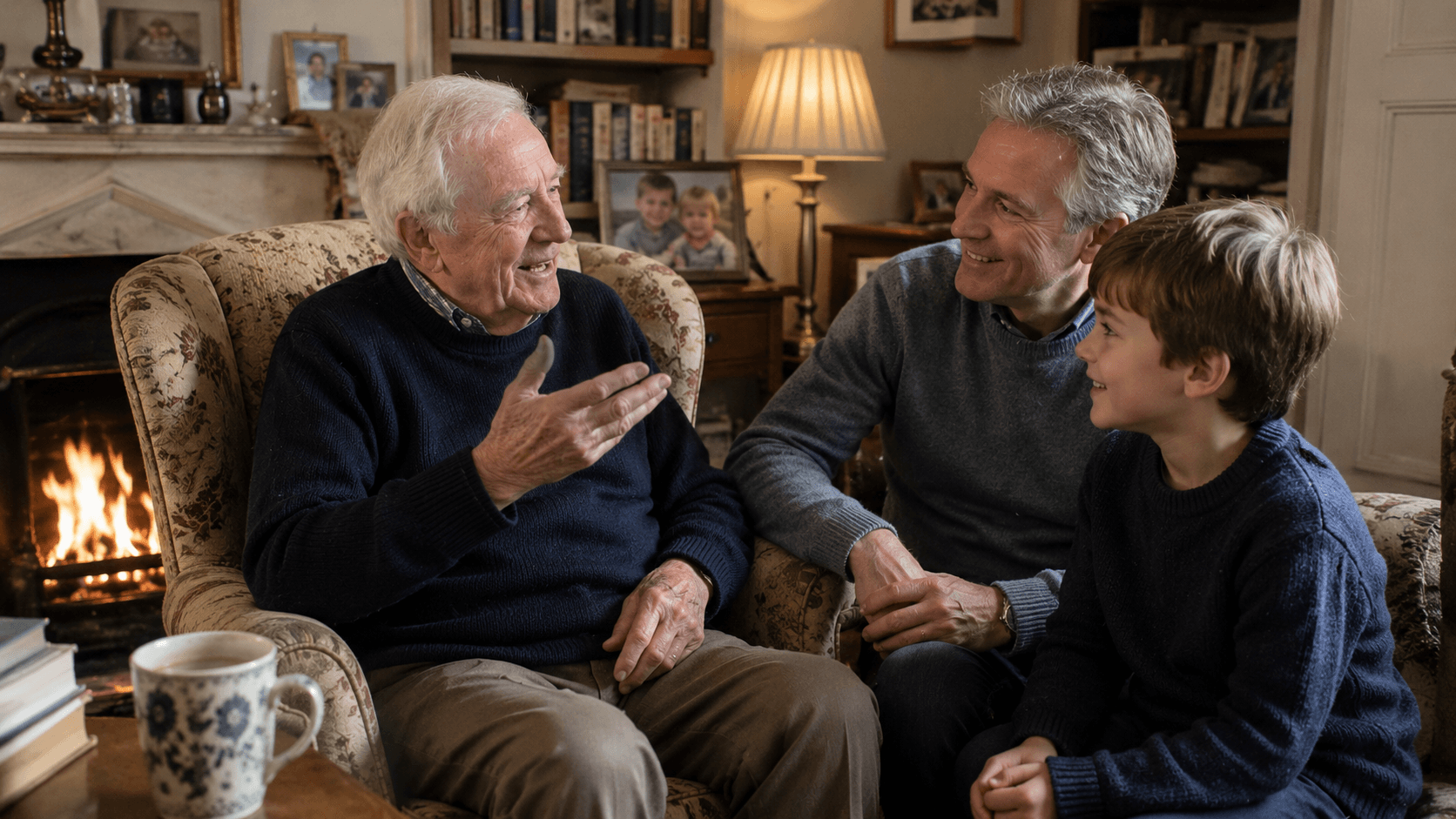
The mechanism is straightforward. When someone tells you about the night they met your mother, or the job they had at seventeen, or the street they grew up on, you are putting their story at the centre of the room. They become the authority, the person with something to offer that nobody else has. You are not filling time together. You are telling them, through the act of asking and listening, that their life is interesting and that their perspective matters.
For someone whose daily life has narrowed, that can be significant. Research from the National Institute for Health and Care Research has found that some older people in residential care have as little as two minutes of meaningful social interaction in a day. As people get older, particularly in a care setting, it is easy to lose a sense of your own value. The days are similar. The world moves on around you. Structured reminiscence, the kind where someone sits with you, asks a considered question, and wants to hear the answer, is one of the most effective ways to reverse that. It reminds the person being asked that they have lived a life full of experience, decisions, and hard-won understanding, and that someone wants to hear about it.
And the person asking the questions gets something too. You hear stories you never knew. You see your parent or grandparent as a young person, making choices, taking risks, falling in love for the first time. You discover that the person you have known your whole life contains decades of experience you have never once asked about. It is a surprisingly good way to spend time together.
If there are children in the picture, the curiosity tends to spread. The pace of change in the last fifty years means a grandparent’s childhood is almost unrecognisable to a seven-year-old, and that gap is exactly what makes the stories compelling. What was school like? What did you eat? What did the street look like? Children are fascinated by how different things were, and a grandparent who has lived through it is the best possible person to tell them. Once a child starts asking “in your times, what was it like when…” those conversations take on a life of their own.
What it looks like in practice
There is no single right way to do this. Here are four that work.
The kitchen table session. A cup of tea, a laptop or tablet open on the Writing Studio, and an afternoon with nothing else booked. You read the questions aloud. They talk. You type what they say, or they do, or you just listen and make notes. One chapter per sitting is a comfortable pace.
The Sunday afternoon archive. Bring the old photo albums. Spread the photographs across the table. Use the Biography Studio questions as a starting point, then follow whatever the photographs trigger. The questions are designed to open doors, and a photograph from 1962 will open ones that nothing else can reach.
The weekly visit. If you visit a parent or grandparent regularly, whether that is every day or once a week, one question per visit gives you both something to look forward to. You do not need a laptop. Ask the question, have the conversation, and write it up at home afterwards. When you leave, give them the next question to think about before your next visit. It gives them something to enjoy turning over in their mind, and do not be surprised if it sparks conversations with other people too, comparing memories of what things were like, swapping stories about places and times they had in common.
The recorded conversation. If they prefer talking to typing, and most people do, record the conversation on your phone. Let them speak freely. Take it home and type it into the Writing Studio later, using their words. Your biographer will tidy the prose for clarity and flow, but the voice stays theirs.
The flexibility is the point. Some people will answer the questions directly, sitting at a screen and working through them in order. Others will want to talk while someone else handles the writing. Some will want to do it in concentrated sessions. Others will prefer one question a week, spread across months. All of these work. The only thing that matters is that the stories get told.
It does not have to be their idea
One thing worth knowing. The person whose life this is does not always need to be the one who suggests it. In fact, they rarely are. Most people do not wake up thinking they should record their life story. The impulse usually comes from someone who loves them, someone who recognises that the stories matter and wants to make sure they survive.
If you are the one starting the conversation, keep it simple. You are not asking them to write a book. You are asking them to tell you about their life, one question at a time, while someone turns it into a book for them. All they have to do is talk. And talking about yourself, when someone is listening properly, is one of the most natural things there is.
For anyone whose visits need a purpose
This one rarely gets said aloud, but everyone recognises it. When you visit an elderly parent or grandparent, particularly one who is housebound or in residential care, the conversation can be difficult. Their day has been similar to yesterday. Yours has been busy. You love each other and you have run out of things to say after ten minutes. You end up talking about what you had for lunch, or sitting together in a silence that feels kind but slightly hollow.
It is not just the infrequent visits where this happens. Sometimes you see someone every day, or they live with you, and the familiarity means you stop asking. They are there, they are loved, but they become part of the background rather than the focus. The stories are right there in the room with you, and nobody is drawing them out.
A Biography Studio project changes that. Over time, each visit becomes something to anticipate, not just seeing someone you love but finding out something new about them. What was their first day at work like. Who was the friend they lost touch with. What did their town look like before the bypass went through. You will be surprised by what comes out, and so will they.
For the person telling the stories, it is a form of return. Not escaping their present, but going back to a version of their life that was wider, louder, fuller. The street they grew up on in the 1950s. The first time they travelled abroad. The work they did, the people they knew, the choices they made. These memories do not diminish with age. If anything, they become more vivid, more detailed, more emotionally present. All they need is the right question to draw them out.
And as you move through the later chapters, particularly in the Wisdom pathway, the questions go further. They ask for perspective, for beliefs, for the things a person has come to understand about life through the act of living it. That is not just conversation. It is saying to someone: I value what you think, and I want it written down.
What you end up with
At the end of the process, you have a hardback book. Royal format, printed on heirloom quality paper, with photographs throughout. Every chapter is a question and an answer, the author’s own words, edited for clarity and flow but never rewritten. It is their voice on every page.
But the book is the proof, not the point. The point is the afternoons you spent together, the stories you heard for the first time, the look on their face when a question took them somewhere they had not been in years. That is the thing you will remember.
Getting started
Biography Studio offers three pathways. Reflections covers the whole life in seven chapters, from childhood through to the present day, and is a complete project on its own. Chronicle and Wisdom add further dimensions, covering the world the author lived through and the things they have come to believe. The Complete Edition includes all three.
You can start a project at biographystudio.com and work through it at whatever pace suits you. If you want to present it to someone, a voucher lets them redeem it in their own time, and you can do the project alongside them from the first question.
The stories are there. They just need someone to ask.
Biography Studio guides you through a life story across thirteen chapters, in your own words, at your own pace. If you want to do it alongside someone you love, start a project and work through it together.
Can someone who is not very mobile or lives in a care home still do a life story project?
Yes. The whole project can be done with a phone or tablet, or without any technology at all. You can ask the questions in conversation, take notes, and type up their answers at home afterwards. All they need to do is talk.
How do you record someone’s life story if they cannot type or use a computer?
They do not need to. You can record the conversation on your phone and transcribe it later, or write up what they said from your notes. If using Biography Studio as a companion guide we offer the option to tidy up your answers for clarity and flow, so it does not need to arrive perfectly written.
How long does a life story session take?
That is up to you. Some people spend an hour or two on a chapter. Others do one question per visit and work through the project over several months. There is no deadline and no pressure to keep to a schedule.
Can more than one family member help with a life story project?
Yes. One person might ask the questions during visits, another might type up the answers, and a third might help choose the photographs. As long as the account holder manages the Writing Studio, anyone can help with the rest.
Can you still write a life story if the person’s memory is not what it used to be?
The questions are designed to prompt recall, not test it. Even partial memories make good chapters. A vivid detail about a childhood kitchen or a half-remembered song from a school assembly is more than enough to build on. And if a question draws a blank, skip it. Woth Biography Studio there are nearly 1,000 questions to choose from so there will alsways be something accessible to talk about.
Do I need to buy a separate Biography Studio account to help someone with their life story?
No. One project covers one life story. You can buy it for yourself and work through it alongside them, or you can purchase a voucher and let them redeem it when they are ready.
What do you get at the end of a life story project?
With Biography Studio you will recieve a hardback book in Royal format, printed on heirloom quality paper, with space for photographs throughout. Every chapter is a question and an answer in their own words, edited for clarity but never rewritten.