From the founder of Biography Studio
Try something. Think of a memory from your childhood. A specific one. A house, a person, a summer. Now notice what your eyes do.
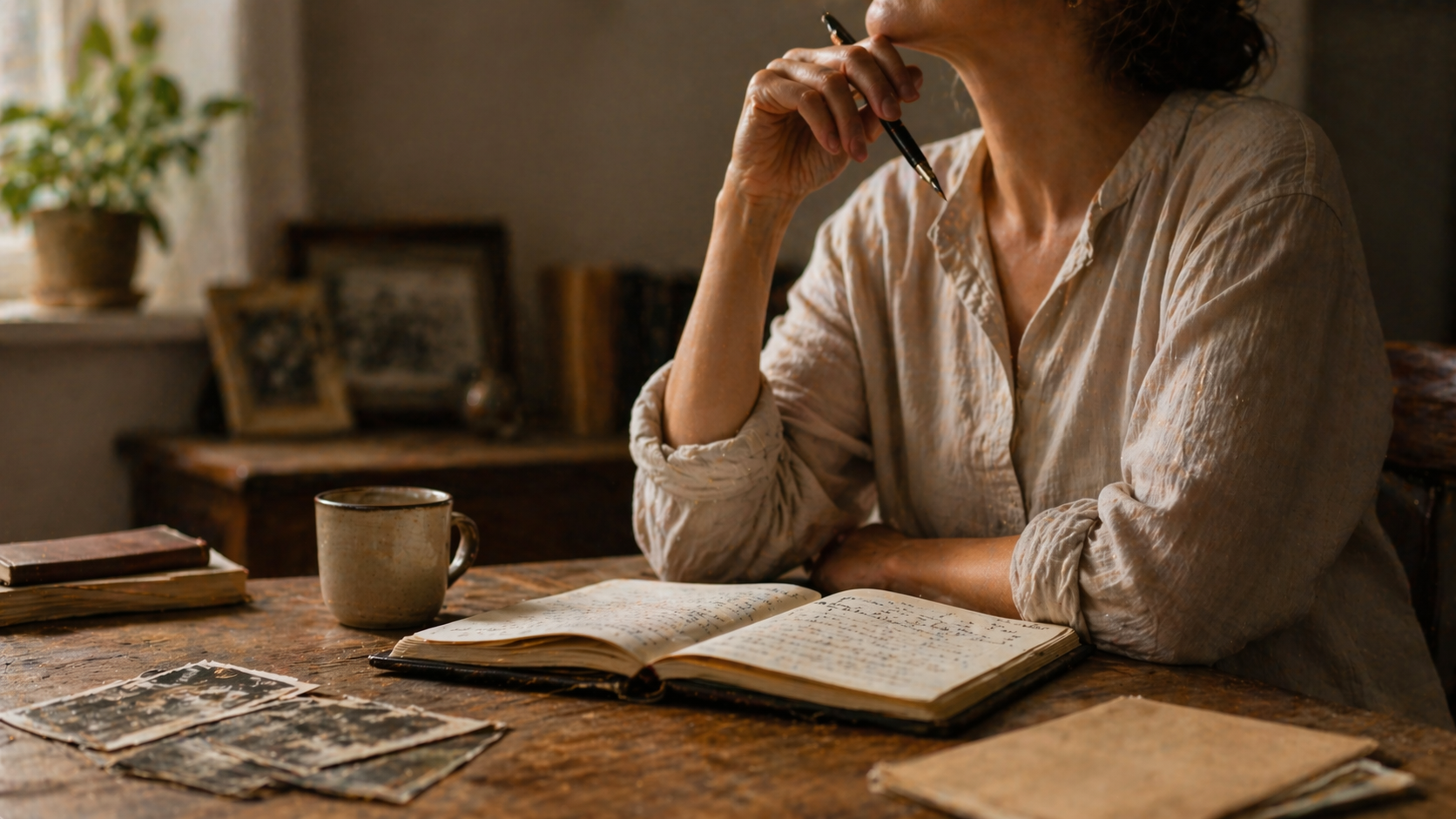
If you are like most people, your gaze will drift upward, or off to one side, toward a blank patch of wall or ceiling. Away from whatever is in front of you. This is not a habit or an affectation. It is your brain doing something deliberate. Memory researchers have found that when we access internal states, particularly autobiographical memories, we instinctively avert our gaze from visual distractors. We look toward empty space because the memory lives inward, and looking outward gets in the way.
Now notice what happens when you sit down to write.
Your eyes drop to the screen. Your attention splits between the memory you are trying to reach and the sentence you are trying to construct. You are doing two cognitively demanding things at once: remembering, and composing. And research consistently shows that writing places significantly higher demands on working memory than speaking aloud. When composition competes with recall, recall tends to lose.
This is the problem with writing your life story by writing it.
What speaking does differently
When you speak, something different happens. The cognitive load of sentence construction, of spelling, of grammar, of how the words will look on the page, all of that falls away. What remains is the memory itself. You follow the thought wherever it goes. You look up. You let your eyes find the empty space. And the material comes.
Memory researchers studying the think-aloud method, where participants verbalise their uninterrupted stream of thought, have found that speaking activates the same neural networks involved in episodic memory retrieval. Speaking and remembering use overlapping brain systems in a way that writing and remembering do not. When you speak freely, you are not fighting your own neurology. You are working with it.
This is also why spoken answers tend to contain more unexpected material. When you are writing, you tend to produce what you already know you want to say. The composed, considered version of the memory. When you speak, things surface that you did not know you were going to say. The name of someone you had forgotten. The specific detail that makes the memory real rather than summarised. The thing that surprises you as it comes out.
This is not unique to memoir. It is why the best interviews, the best oral history, the best ethnographic research, has always been done face to face, in conversation, where the subject is speaking rather than composing.
The caveat worth naming
Speaking freely and speaking well are two different things.
If you simply open your mouth and let whatever comes out be the finished version, you will produce an answer that sounds like someone thinking out loud. Which has its virtues, but has its limits too. The spoken word has its own patterns: the repeated phrases, the circling around a point, the thought that arrives before the sentence that was supposed to introduce it.
This is where a small amount of preparation changes everything. Before you speak, spend a moment with the question. Let the memory surface. Make a few notes, a name, a place, a rough shape of where the answer might go. Then speak from that loose framework rather than from nothing. You are not scripting it. You are giving yourself enough structure to follow the memory rather than search for it while simultaneously constructing a sentence.
The difference between a sprawling answer and a rich one is rarely the depth of the memory. It is whether the speaker had any sense of where they were going before they began.
Speaking as part of the experience
There is also a version of speaking that has nothing to do with recording an answer at all.
Some of the richest material in any Biography Studio project comes not from sitting alone with a question but from talking about it with someone who was there. Calling a sibling and asking if they remember the same thing. Sitting with a parent and letting the question be the start of a conversation rather than a prompt for a monologue. Comparing memories, disagreeing about details, laughing at the discrepancies.
What tends to happen in those conversations is revealing. Two people who were present at the same moment often remember it from completely different standpoints. Details that have fragmented away from your memory are intact in theirs. Things you were not even aware of at the time come back through someone else’s account of it. The combined version of a memory is almost always richer than either version held alone.
But beyond the material, these conversations are part of what Biography Studio is actually for. The project is not a race to the finished book. It is an opportunity to go back through a life with the attention it deserves, and speaking to the people who shared parts of it is one of the best ways to do that. The question is the starting point, not the destination. The conversation that follows, the laughter, the corrections, the things nobody had thought about in decades, that is the experience the project exists to produce.
Speak first. Write later. The answer you eventually record will be richer for it. And the time spent getting there will be worth having in its own right.
What this means practically
Biography Studio has a voice input tool built in. You can click a button, speak your answer at your own pace, and your words appear on screen. The editorial process then shapes what you have said into clean, readable prose, handling the roughness of spoken language while preserving everything specific to you.
But the more important point is not the technology. It is the approach. Whether you use voice input or simply speak your answer to yourself before you type it, the principle is the same. Look away from the screen. Let your gaze find the empty space. Follow the memory rather than constructing the sentence.
The writing will take care of itself. The remembering is the part that requires your full attention.
The craft of answering questions well is covered in more detail in our guide to getting the best from your Biography Studio project.